
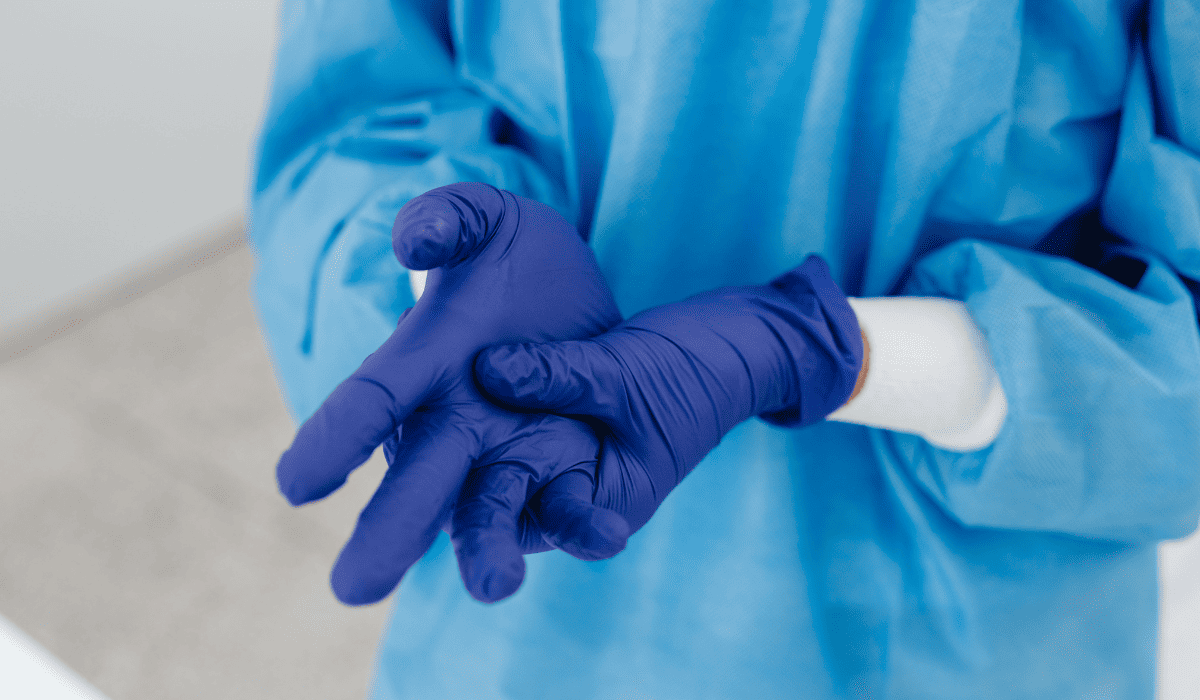
Cleanrooms are essential in many industries to maintain cleanliness and control contamination, including chemical residues and skin flakes that can damage products if not properly managed.
For industries such as aerospace, biotechnology, electronics, and manufacturing, cleanroom gloves and supplies play a key role in ensuring quality and safety in controlled environments.
Accuracy is critical in cleanroom settings, which is why choosing the right cleanroom supplies and gloves is important for everyday tasks.
They help protect sensitive products and personnel while maintaining consistent environmental control.
Cleanroom gloves and supplies also support regulatory compliance and enable research and production processes to run smoothly.
Selecting the right types helps keep the environment clean, compliant, and properly sterilized across different cleanroom applications.
In this guide, we will help you understand the different classifications and types of cleanroom gloves and supplies used in controlled environments.
Understanding the Difference Between Cleanroom Gloves and Cleanroom Supplies
Cleanroom Gloves
Cleanroom gloves are specialized products designed to protect hands from contamination and microbes.
These gloves are used in environments where tasks are highly sensitive and require strict contamination control.
Cleanroom gloves are commonly used in sectors such as medical devices, semiconductors, biotechnology, research laboratories, and chemical and life sciences.
They are made from materials such as nitrile, neoprene, latex, and polyisoprene. This category also includes finger cots, chemical-resistant gloves, and inspection gloves.
Cleanroom gloves are manufactured according to ISO standards and are available in different classes to meet sterile or non-sterile requirements based on specific working conditions.
The purpose of cleanroom gloves is to minimize ionic contamination, chemical contamination, microbial growth and other extractables from spaces so that operations can be performed well.
They are often tested, washed, and packed in conditions that are safe and clean.
These gloves are available in a range of ambidextrous and hand-specific variations and mostly come in the sizes of small, large, and XL to XXL.
The primary role of cleanroom gloves is twofold:
- To protect sensitive products and processes from human-borne contamination.
- To protect personnel from hazardous substances.
As hands are one of the most significant sources of contamination in a cleanroom, selecting the correct glove type is critical for maintaining compliance and operational reliability.
What Are Cleanroom Supplies?
Cleanroom supplies are specialized equipment and products used in highly controlled environments.
Typical cleanroom supplies include apparel, gloves, face masks, wipers, mops, easy-to-clean flooring, HEPA filters, and many more.
All of these supplies are available at UltraPure Technology to support your cleanroom facilities and control contamination and performance of cleanroom conditions.
Two Types of Common Gloves in Cleanroom and Their Uses
Gloves are first classified into two broad categories, such as disposable and reusable gloves.
Both of them have own uses and are required for different application tasks.
Disposable Gloves
With its name, you can understand that it is a single-use glove, and later you can discard it.
Materials used in disposable gloves include vinyl, latex, and nitrile.
These gloves are highly sensitive and used in industries like food service, healthcare, cleanrooms, labs, etc.
These are suitable for high environments and regulated industries, making it an ideal solution for inventory management.
Disposable gloves are lightweight and thin, and that’s why people always discard them after a single use.
The purpose of disposable gloves is to ensure easy management of inventory and keep the environment extremely clean and contaminate-free.
Reusable Gloves
Reusable gloves are durable, resistant to chemicals, and can be cleaned after every use.
These gloves include PVC, thick nitrile, neoprene, chemical-resistant, or rubber-like material.
Due to the good thickness of the gloves, they can be used many times and are safe against abrasion and heat.
However, experts suggest cleaning and drying on a timely basis so that it works best in industries like research and science, manufacturing, and agriculture.
Wearing reusable gloves is also crucial for industries that have more sanitization and cleaning requirements.
They can be preferred for applications where cost-efficiency and durability are prioritized.
Detailed Explanation of 7 Types of Cleanroom Gloves Based on Material
The material used in cleanroom gloves can vary from each other, and each has their own features and unique purposes, advantages, or disadvantages.
The most bought gloves available at UltraPure Technology are as follows:
Latex Gloves
Latex gloves are used in biotechnology laboratories, pharmaceutical cleanrooms, and sterile healthcare environments.
They are made from natural rubber latex to support operations of medical devices, aseptic processing areas, and applications that require precision and motor control.
Latex gloves are powder-free and are known for high comfort and elasticity.
Due to their sensitivity, they are manufactured with great care and help industries maintain quality during inspections and laboratory operations.
Key Features
- Excellent stretchability and snug fit
- High tactile sensitivity for delicate tasks
- Powder-free to avoid contamination
- Low protein and low extractables (cleanroom processed)
- Available in hand-specific or ambidextrous designs
- Textured or smooth surface options
- Suitable for ISO Class 4–7 cleanrooms
- Not recommended for users with latex allergies
Vinyl Gloves
Vinyl gloves are made from polyvinyl chloride (PVC) and are used in non-critical cleanrooms.
They are highly economical and fantastic for low-level inspection tasks and general laboratory work, and where contamination risk is low-level.
Vinyl cleanroom gloves are used for short-term use.
They are produced from polyvinyl chloride to bring comfort for high-volume operations.
Compared to their alternatives, such as latex or nitrile, vinyl gloves are less durable.
However, vinyl gloves offer lower durability and chemical resistance compared to nitrile or latex.
Key Features
- Latex-free and economical
- Smooth, loose fit for easy donning
- Anti-static options available
- Lower chemical and puncture resistance than nitrile
- Suitable for short-term use
- Compatible with ISO Class 7–8 cleanrooms
- Best for tasks with minimal mechanical stress
Nitrile Gloves
Nitrile gloves are ideal for life-science labs, electronic cleanrooms, pharmaceutical manufacturing, and chemical-dealing environments.
They include synthetic rubber material to offer versatility and maximum protection in controlled environments.
Modern cleanrooms use nitrile gloves because of low particle shedding and chemical resistance.
Due to their latex-free capacity, nitrile gloves are used as ISO cleanroom gloves and ideal for GMP settings, chemical laboratories, biotechnology, pharmaceuticals, and manufacturing
Their low particle and ionic infiltration levels make them suitable for sensitive processes, while their durability allows for extended wear in demanding applications.
Nitrile gloves are often considered the best all-around choice because they combine comfort, safety, and regulatory compliance without the allergy concerns associated with latex.
Key Features
- Allergy-safe
- High chemical and puncture resistance
- Low particles, ions, and extractables
- Powder-free and cleanroom washed
- Good grip with textured fingertips
- Available in sterile and non-sterile versions
- Compatible with ISO Class 4–8 cleanrooms
- Longer wear life compared to latex and vinyl
Chemical-resistant Gloves
These are heavy-duty gloves that provide protection against acids, harmful chemicals, and solvents.
They are thicker than other cleanroom gloves and have the capacity to work under harsh conditions.
They are commonly used for cleaning tasks, chemical handling, industrial cleanrooms, chemical labs, and advanced laboratory research.
Chemical-resistant cleanroom gloves provide a protection layer to both processes and personnel and help deal with dangerous substances.
Key Features
- High resistance to acids, caustics, oils, and solvents
- Made from nitrile, neoprene, latex, or blended compounds
- Thicker construction for extended protection
- Textured or embossed grip for safety
- Enhanced durability and abrasion resistance
- Not always suitable for ultra-critical particle-controlled zones
Coated Gloves
Coated gloves have a coating of foam, nitrile, or fabric, or they are polyurethane material because they are not disposable and handle contamination control without any compromise.
These gloves are applied to the palm and fingers in order to make a grip for avoiding slippage and other risks.
A special surface coating is included in it to improve the durability of gloves and handle tools with ease.
Key Features
- Excellent grip and abrasion resistance
- High dexterity and comfort
- Cut-resistant options available
- Breathable fabric backing
- Reusable and durable
- Used mainly outside critical cleanroom zones
Inspection Gloves
Inspection thin gloves are used to inspect products, finished goods, and optical components.
Their fabric is very lightweight and made from three different materials, such as polyester, nylon, or cotton. cotton, nylon, or polyester.
The goal of using inspection gloves in quality control environments is to avoid skin oils, fingerprints, and dust particles during operations.
These gloves come with maximum tactile sensitivity, precise fitting, and low-lint construction to help users handle delicate activities and find surface defects with confidence.
If you want to maintain accuracy, these gloves are suitable for your work, including optics, electronics, quality inspection, precision assembly, and quality inspection.
Key Features
- Low lint and soft material
- Comfortable for extended use
- Seamless or cut-and-sewn designs
- Prevents fingerprints and smudges
- Not intended for chemical or liquid protection
- Ideal for dry, clean handling tasks
Finger Cots
Finger cots are another type of functional glove used to repair cleanroom work.
It covers fingers with small protection and ensures that you can handle products without risks of particles, salts, or skin oils.
As you know, they are only designed for fingers. Therefore, use them in laboratory, microelectronics, or tasks where full-length gloves are not needed.
They are suitable for local contamination management and spaces where fingers easily contact with contamination.
Key Features
- Made from latex, nitrile, or vinyl
- Powder-free and cleanroom processed
- Anti-static and ESD-safe options available
- Excellent fingertip control and dexterity
- Compatible with ISO Class 5 (Class 100) cleanrooms
- Cost-effective alternative to full gloves
Classification of Cleanroom Supplies
The classification of cleanroom supplies is done based on their particular role in contamination control and ability to perform particular functions.
Personal Protective Equipment (PPE): Gloves, cleanroom apparel, face masks, and shoe covers used to prevent human-borne contamination.
Cleaning and Maintenance Supplies: Wipers, mops, disinfectants, and cleaning tools designed for low particle generation.
Environmental Control Supplies: Flooring systems, sticky mats, HEPA filters, and air control components that help maintain cleanroom conditions.
Monitoring and Packaging Supplies: Particle counters, cleanroom stationery, and packaging materials used to support compliance and traceability.
Conclusion
Gloves and supplies are essential in cleanrooms to ensure performance, safety, and compliance in controlled environments.
Above, we have discussed the classification of different gloves used across industries based on their requirements, material, cleanliness level, and specific applications.
However, you can choose them according to your operational requirements and need to control contamination.
But don’t forget to invest in a certified cleanroom company because it has both ISO-certified and GMP cleanroom supplies and gloves to ensure desired performance, consistent quality, and long-term support.
For your information, we would like to let you know that we are also an experienced cleanroom supplier at UltraPure Technology.
Our team has a wide variety of gloves, cleanroom clothes, flooring, and other supplies to meet your unique cleanroom conditions needs.
For more information, visit our website today.
Frequently Asked Questions
What’s the difference between latex, nitrile, and vinyl cleanroom gloves?
Latex gloves offer the best stretch and tactile sensitivity but aren’t suitable for anyone with a latex allergy. Nitrile gloves are latex-free, offer strong chemical resistance and low particle shedding, and are often considered the best all-around choice for critical cleanroom work. Vinyl gloves are the most economical option but offer lower chemical resistance and durability, making them better suited to short-term, low-risk tasks in less critical (ISO Class 7-8) environments rather than tightly controlled processes.
What ISO class cleanrooms are vinyl gloves suitable for?
Vinyl gloves are generally compatible with ISO Class 7-8 cleanrooms, where contamination risk is lower and mechanical stress on the glove is minimal. For more critical environments or tasks involving chemical exposure, nitrile or latex gloves are a better fit.
When should I use inspection gloves instead of standard cleanroom gloves?
Inspection gloves are designed for dry, delicate handling tasks like quality inspection, optics, and precision assembly, where preventing fingerprints, smudges, and lint matters more than chemical or liquid protection. They’re not a substitute for standard cleanroom gloves in tasks involving chemical handling or where liquid protection is needed.
Are cleanroom gloves powdered or powder-free, and does it matter?
Most cleanroom gloves, including latex and nitrile options, are manufactured powder-free. This matters because glove powder can itself become a source of particle contamination inside a cleanroom, working against the exact contamination control the glove is meant to support. Powder-free gloves are the standard choice for nearly all cleanroom applications.
Can cleanroom gloves cause allergic reactions?
Yes, latex gloves can trigger allergic reactions in people with a latex sensitivity, which is a common enough concern that many facilities standardize on nitrile gloves instead. Nitrile is latex-free and offers comparable protection and dexterity without the allergy risk, which is part of why it’s often considered the best all-around choice for cleanroom use.
What size cleanroom gloves should I order?
Cleanroom gloves are typically available in small through XL/XXL, in both hand-specific and ambidextrous designs. Getting the fit right matters more in cleanroom settings than in general-purpose use, since a poor fit can reduce the tactile sensitivity and dexterity needed for precision tasks. Facilities often keep a range of sizes on hand to fit different staff members correctly rather than standardizing on one size.
Do finger cots replace full cleanroom gloves?
No, Finger cots are designed for tasks where only fingertip protection is needed, such as certain microelectronics or laboratory work, and they offer excellent dexterity for that purpose. For any task involving broader hand contact with a product or surface, a full cleanroom glove is still required
What are ISO Cleanroom Gloves?
Cleanroom gloves are classified according to ISO cleanliness standards to match the contamination control needs of different environments. UltraPure Technology offers ISO-classified cleanroom gloves designed to help facilities meet the particle and cleanliness requirements of their specific ISO class.
What are Sterile Cleanroom Gloves?
Sterile gloves are used for applications that require proper sterilization and the lowest possible level of microbial contamination. They’re common in healthcare and other environments where task criticality demands strict product and patient safety.
Why buy good cleanroom gloves and what makes them of high quality?
High-quality cleanroom gloves are manufactured and packaged in controlled conditions to minimize particle shedding. A good fit and appropriate thickness also matter, since gloves that are uncomfortable or overly bulky can lead to more frequent removal and reduced compliance. Quality gloves should meet ISO and GMP standards consistently, which supports easier audits and more reliable inspection outcomes. Sourcing gloves from a trusted supplier helps ensure that consistency over time.
Why do you pick the right cleanroom gloves and supplies?
Choosing the right gloves and supplies isn’t just a purchasing decision, it directly affects contamination risk, worker safety, and regulatory compliance. The right choice depends on the specific ISO class, task, and material compatibility required for your environment.