Cleanrooms are specialized environments designed to control contamination and maintain extremely low levels of particulates, dust, microbes, and chemical vapors.
They are vital in industries such as pharmaceuticals, biotechnology, semiconductor manufacturing, and aerospace, where even minor contamination can compromise products or processes.
However, constructing a cleanroom is only the first step.
Ensuring that it meets stringent regulatory and operational standards requires thorough validation and testing, a critical phase handled meticulously by professional cleanroom installers.
This article explores the processes and best practices cleanroom installers follow to validate and test cleanrooms after construction, ensuring they meet design specifications and regulatory requirements.
Understanding Cleanroom Validation
Validation is the documented process of confirming that a cleanroom operates according to its intended specifications.
It demonstrates that the environment consistently maintains the required level of cleanliness and supports regulatory compliance, such as the guidelines set by ISO (International Organization for Standardization) 14644 standards, FDA (Food and Drug Administration), or EU GMP (Good Manufacturing Practices).
Validation is not a one-time event; it is a systematic process that encompasses design qualification (DQ), installation qualification (IQ), operational qualification (OQ), and performance qualification (PQ).
- Design Qualification (DQ): This phase ensures that the cleanroom design meets the functional and regulatory requirements before construction.
- Installation Qualification (IQ): Post-construction, installers verify that all equipment, systems, and components have been installed according to the approved design.
- Operational Qualification (OQ): This involves testing the cleanroom under controlled conditions to ensure that all systems operate correctly.
- Performance Qualification (PQ): Finally, installers confirm that the cleanroom performs effectively under normal operating conditions, maintaining required cleanliness levels consistently.
What Is the Cleanroom Validation Process?
The cleanroom validation process is a structured series of checks used to confirm that a cleanroom performs according to its intended design, cleanliness classification, and operational requirements.
For cleanroom installers, validation is not only about confirming that the room was built correctly. It also verifies that the controlled environment can support the process it was designed for.
The process usually begins with a review of design and installation records. This helps confirm that the cleanroom construction matches the approved specifications, including wall systems, ceiling systems, HVAC layout, filter placement, pressure control, and utility connections.
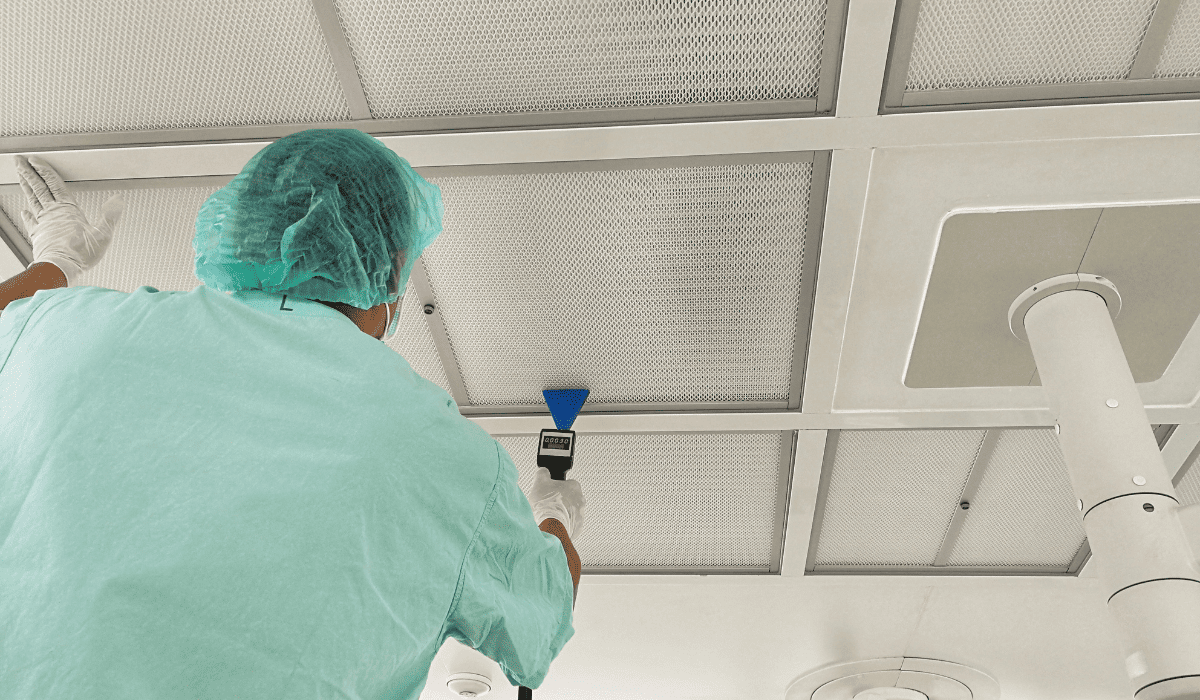
After this review, testing moves into physical performance checks. These may include airborne particle counting, airflow visualization, HEPA or ULPA filter integrity testing, pressure differential testing, temperature and humidity verification, and environmental monitoring.
Each test helps confirm that the room is not only complete, but also functioning as a controlled environment.
Post-Construction Validation and Testing Steps
After cleanroom construction, the validation and testing process involves multiple stages and a combination of equipment and scientific techniques.
Cleanroom installers follow structured steps to ensure every aspect of the environment meets strict standards.
Documentation Review and System Checks
Before any physical testing begins, installers conduct a thorough review of all design documentation, system specifications, and installation records.
They verify:
- HVAC system design and airflow patterns.
- Materials used in walls, ceilings, and flooring.
- Placement and functionality of HEPA/ULPA filters.
- Electrical, plumbing, and control systems.
Installers also ensure that all equipment is calibrated and functioning correctly, establishing a solid baseline for subsequent validation.
Airborne Particle Counting
Air cleanliness is the cornerstone of cleanroom performance.
Airborne particle counts are conducted using laser particle counters, which measure the concentration of particles of different sizes in the air.
- ISO Classifications: Cleanrooms are classified based on the number of particles per cubic meter at specific particle sizes. For example, an ISO Class 5 cleanroom allows only 3,520 particles per cubic meter of 0.5 microns or larger.
- Testing Procedure: Installers take measurements at multiple points throughout the cleanroom to verify uniform airflow and contaminant control.
- Trend Analysis: Particle counts may be measured under dynamic conditions (with staff operating inside the cleanroom) to simulate real-world conditions.
This testing ensures that the cleanroom consistently meets its designated cleanliness class.
What Is the ISO Standard for Cleanroom Validation?
The main ISO standard used for cleanroom classification is ISO 14644. This standard helps define airborne particle limits for different cleanroom classes and provides the framework for confirming whether the cleanroom meets its required cleanliness level.
For an iso cleanroom, validation must confirm that particle levels remain within the allowed limits for the target classification. This is why particle counting is one of the most important steps after cleanroom installation. Testing is performed at defined locations inside the cleanroom to verify that air cleanliness is consistent across the controlled space.
ISO-related validation may also include airflow testing, pressure checks, filter integrity testing, recovery testing, and environmental condition verification, depending on the cleanroom design and industry requirements. The goal is to prove that the cleanroom can maintain the required air quality under the conditions it was designed to support.
Airflow Visualization and Smoke Studies
Proper airflow prevents the accumulation of contaminants.
Cleanroom installers use smoke or fog tests to visualize airflow patterns and identify dead spots, turbulence, or recirculation areas.
- Smoke Testing: Non-toxic smoke is released at strategic points, and its movement is observed to confirm unidirectional airflow or laminar flow where required.
- Airflow Mapping: Anemometers or hot-wire probes measure airflow velocity and uniformity, ensuring the HVAC system delivers consistent air changes per hour (ACH).
- Pressure Differentials: Differential pressure measurements between cleanroom zones are checked to prevent cross-contamination, especially in areas with varying cleanliness levels.
How Do Clean Room Testing Methods Work?
Clean room testing methods work by measuring whether the controlled environment is performing as designed.
Each test looks at a specific part of cleanroom performance, and together they create a complete picture of air quality, airflow behavior, filtration performance, and environmental stability.
Particle counting measures how many airborne particles are present at specific sizes. Airflow visualization shows how air moves through the room and whether there are dead spots, turbulence, or recirculation areas.
Filter integrity testing checks whether HEPA or ULPA filters are properly sealed and functioning. Pressure differential testing confirms that air is moving in the correct direction between cleanroom zones.
Environmental checks are also important. Temperature, humidity, and pressure must remain within the required range because they can affect product quality, contamination risk, and cleanroom performance.
For facilities that need ongoing support after validation, a cleanroom environmental service can help review these conditions over time and identify early signs of performance drift.
HEPA/ULPA Filter Integrity Testing
Filters are critical in maintaining particulate control.
After installation, cleanroom installers perform integrity tests to verify that HEPA or ULPA filters are properly installed and functioning:
- Aerosol Challenge Test: Filters are exposed to a controlled aerosol, and downstream particle concentration is measured to detect leaks.
- Flow Rate Verification: Airflow through each filter is measured to ensure it meets design specifications without causing turbulence or recirculation.
Surface and Environmental Monitoring
Cleanrooms must maintain not only clean air but also clean surfaces.
Surface and environmental monitoring ensures that particulate levels and microbial contamination remain within limits:
- Surface Sampling: Swabs or contact plates are used to collect samples from work surfaces, walls, and floors.
- Microbial Monitoring: Culturing samples helps detect bacteria, fungi, or other microbes, particularly in pharmaceutical or biotech cleanrooms.
- Settling Plates: These passive sampling tools capture airborne particles that settle on surfaces over time, giving a practical picture of contamination risks.
Temperature, Humidity, and Environmental Controls
Cleanrooms often require precise control of temperature and humidity to maintain product quality and prevent microbial growth.
Installers validate environmental controls by:
- Recording temperature and relative humidity at multiple points.
- Testing sensors and controllers for accuracy and responsiveness.
- Ensuring alarm systems and automated controls function correctly to maintain consistent environmental conditions.
Electrical and Lighting Checks
Proper lighting and electrical integrity are vital for both safety and process reliability.
Cleanroom installers verify:
- Emergency lighting and backup power systems.
- Lighting levels that comply with operational requirements without introducing heat or particulate sources.
- Electrical grounding and shielding to prevent electrostatic discharge, critical in semiconductor manufacturing.
Process Simulation and Functional Testing
In many industries, the cleanroom must accommodate specialized equipment or processes.
Cleanroom installers conduct functional tests:
- Simulating actual production conditions to observe system performance.
- Operating critical machinery to ensure airflow and environmental control are not compromised.
- Validating cleanroom gowning procedures and personnel protocols to minimize contamination.
Documentation and Regulatory Compliance
After all tests are completed, cleanroom installers compile a comprehensive validation report.

This documentation includes:
- Test procedures and protocols.
- Measured results and deviations from standards.
- Corrective actions taken for any discrepancies.
- Certifications and sign-offs from qualified personnel.
These records are crucial for regulatory compliance audits and provide a reference for ongoing monitoring and maintenance.
What Is the Difference Between Qualification and Validation of a Cleanroom?
Qualification and validation are closely related, but they are not exactly the same.
Qualification focuses on proving that individual systems, components, and operating states meet defined requirements.
Validation looks at the full cleanroom environment and confirms that it consistently performs as intended.
In cleanroom projects, qualification often includes stages such as Design Qualification, Installation Qualification, Operational Qualification, and Performance Qualification.
These stages confirm that the cleanroom design is appropriate, the cleanroom installation was completed correctly, the systems operate as expected, and the cleanroom performs under normal conditions.
Validation uses these qualification results as part of the larger proof that the cleanroom is suitable for its intended use.
This distinction is important because a cleanroom can be installed correctly but still require additional testing to prove long-term performance.
Professional cleanroom installers help connect both parts of the process. They verify the installation details, support performance testing, and help create the documentation needed for compliance, audits, and future revalidation.
Ongoing Monitoring and Revalidation
Cleanroom validation is an ongoing commitment.
Post-construction, installers often assist clients with establishing monitoring programs, including:
- Routine particle counting and microbial testing.
- Scheduled filter replacement and HVAC maintenance.
- Annual or periodic revalidation to ensure compliance with evolving standards.
This proactive approach ensures the cleanroom continues to meet stringent operational requirements over its lifespan.
Cleanroom Facility Services After Validation
Validation confirms that a cleanroom meets its requirements at a specific point in time. Long-term performance depends on what happens after the initial testing is complete. Filters load with particles, HVAC systems experience normal wear, sensors can drift, and production changes may affect airflow or pressure balance.
Cleanroom facility services help maintain performance after validation by supporting routine inspections, monitoring reviews, filter testing coordination, HVAC checks, calibration support, documentation review, and revalidation planning. These services help facilities identify small issues before they become larger contamination, compliance, or downtime problems.
For high-control environments, ongoing support is especially important. A cleanroom that passed initial validation may still need adjustments after equipment changes, staffing increases, process modifications, or room updates. A structured cleanroom service plan helps keep the environment aligned with its intended use over time.
Challenges in Cleanroom Validation
Validating a cleanroom is complex and requires attention to numerous variables.
Common challenges include:
- Ensuring uniform airflow in large or irregularly shaped spaces.
- Detecting micro-leaks in filters or walls.
- Balancing environmental controls with human activity inside the cleanroom.
- Keeping detailed documentation to satisfy regulatory inspections.
Professional cleanroom installers are trained to anticipate these challenges and implement solutions, such as modular airflow adjustments, corrective maintenance, or enhanced monitoring protocols.
Conclusion
Validation and testing are essential steps after constructing a cleanroom.
They ensure that the facility not only meets design specifications but also complies with regulatory standards, guaranteeing product safety and quality.
Professional cleanroom installers handle this process with precision, using a combination of documentation review, particle counting, airflow analysis, environmental monitoring, filter integrity testing, and functional simulations.
From initial verification to ongoing monitoring, their meticulous approach ensures cleanrooms operate reliably, protecting both products and personnel.
In high-stakes industries like pharmaceuticals, biotechnology, and electronics, this rigorous validation process is not optional—it is critical for operational success.
Hire UltraPure Technology for Cleanroom Validation and Service Support
Cleanroom validation and testing are essential after construction, but long-term performance depends on proper documentation, environmental monitoring, revalidation, and ongoing service support.
UltraPure Technology helps facilities with cleanroom installation support, validation planning, cleanroom environmental service, and cleanroom facility services for critical environments.
Whether your cleanroom needs post-construction testing support, revalidation guidance, or long-term cleanroom service, our team can help protect performance, compliance, and operational reliability.
Contact our service providers to discuss your cleanroom validation, testing, or service needs.
FAQs
What is cleanroom validation, and why is it important?
Cleanroom validation is the documented process of confirming that a cleanroom meets its intended design and operational standards. It is crucial because even minimal contamination can compromise product quality, regulatory compliance, and personnel safety, particularly in pharmaceutical, biotech, and electronics industries.
What are the main stages of cleanroom validation?
Cleanroom validation typically follows four stages:
- Design Qualification (DQ): Ensures the design meets functional requirements.
- Installation Qualification (IQ): Confirms equipment and systems are installed correctly.
- Operational Qualification (OQ): Tests systems under controlled conditions.
- Performance Qualification (PQ): Verifies the cleanroom performs as expected during normal operations.
How do installers test air cleanliness in a cleanroom?
Air cleanliness is measured using laser particle counters that detect particles of various sizes. Multiple sampling points are used to ensure uniformity, and tests may be conducted under both static (empty room) and dynamic (staff present) conditions.
What is the purpose of airflow visualization tests?
Airflow tests, often using smoke or fog, help verify that air moves according to design specifications, identifying dead zones, turbulence, or recirculation that could compromise cleanliness. They also help confirm proper differential pressure between cleanroom zones.
How are HEPA and ULPA filters tested after installation?
Filters undergo integrity testing, including aerosol challenge tests, which expose the filter to controlled particles to detect leaks. Flow rate measurements ensure that air passes through filters uniformly without disrupting airflow patterns.
Are microbial tests necessary in all cleanrooms?
Microbial testing is essential in environments where biological contamination can affect products, such as pharmaceuticals and biotechnology. In other industries, it may be optional, depending on contamination risk assessments.
How do cleanroom installers ensure environmental control parameters like temperature and humidity are maintained?
Installers use calibrated sensors to monitor temperature, relative humidity, and pressure at multiple points in the cleanroom. They verify that automated control systems maintain these parameters within design tolerances.
What documentation is created during cleanroom validation?
Cleanroom validation documentation includes installation records, test protocols, measured results, deviations from standards, corrective actions, and sign-offs. This documentation is essential for regulatory compliance and future audits.
How often should cleanrooms be revalidated?
Revalidation frequency depends on regulatory guidelines and industry standards. Typically, it occurs annually, after major equipment changes, or after modifications to the cleanroom infrastructure.
Can cleanroom installers help with ongoing monitoring after validation?
Yes, many professional installers assist clients with environmental monitoring programs, routine particle and microbial testing, filter replacement schedules, and documentation practices to ensure long-term compliance and optimal performance.
What is the cleanroom validation process?
The cleanroom validation process confirms that a cleanroom meets its intended design, cleanliness class, and operating requirements. It typically includes documentation review, DQ, IQ, OQ, PQ, particle counting, airflow testing, filter integrity testing, pressure checks, environmental control testing, and final reporting.
How do clean room testing methods work?
Clean room testing methods work by measuring different parts of cleanroom performance. Particle counters measure airborne contamination, smoke studies show airflow patterns, filter integrity tests detect leaks, and pressure, temperature, and humidity checks confirm environmental stability.
What is the ISO standard for cleanroom validation?
The main ISO standard used for cleanroom classification is ISO 14644. It defines airborne particle concentration limits for different cleanroom classes and is commonly used during validation to confirm whether an iso cleanroom meets its required cleanliness level.
What is the difference between qualification and validation of a cleanroom?
Qualification confirms that cleanroom systems and components meet defined requirements through stages such as DQ, IQ, OQ, and PQ. Validation uses those results to confirm that the complete cleanroom environment consistently performs as intended for its process.
Why is cleanroom service important after validation?
Cleanroom service is important because cleanroom conditions can change after validation. Filters load, sensors drift, HVAC systems wear, and production changes can affect airflow or pressure. Ongoing service helps maintain performance and supports future revalidation.
What do cleanroom facility services include?
Cleanroom facility services may include filter testing coordination, HVAC checks, airflow review, pressure monitoring, sensor calibration support, documentation review, and revalidation planning. These services help maintain cleanroom performance after construction and validation.
When should cleanroom installers support revalidation?
Cleanroom installers may support revalidation after room modifications, equipment changes, failed particle counts, HVAC adjustments, filter replacement, production changes, or scheduled compliance reviews. Revalidation helps confirm that the cleanroom still performs as required.