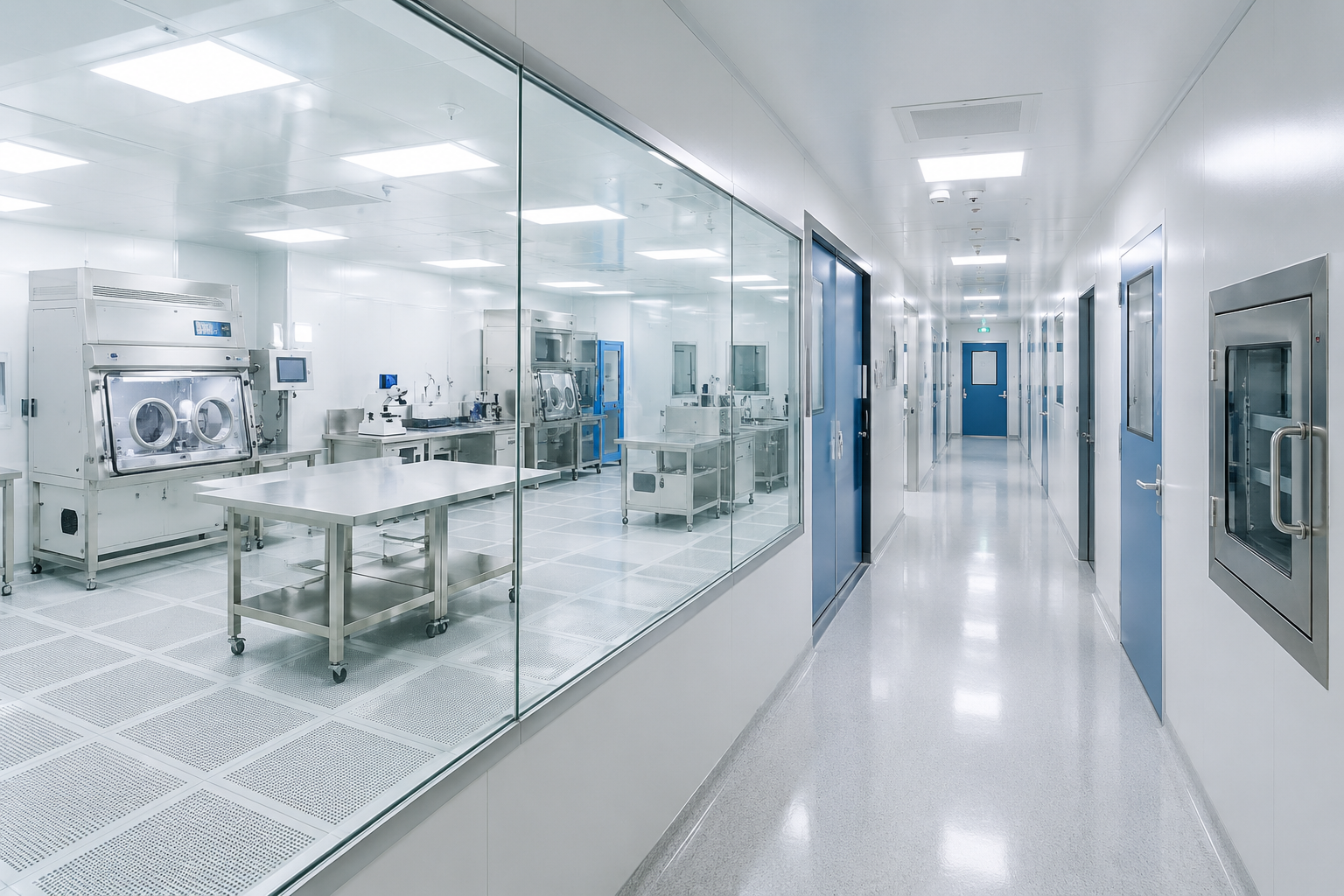
Cleanroom construction companies play an important role in helping manufacturers, laboratories, and regulated facilities create controlled environments that support product quality, contamination control, and long-term operational performance. In industries such as pharmaceutical manufacturing, medical device production, biotechnology, semiconductor, microelectronics, aerospace, and advanced manufacturing, a cleanroom is not simply another room inside a facility. It is a specialized environment that must be planned, built, tested, and maintained with precision.
For companies in Suwanee, GA and the surrounding Atlanta metro area, choosing the right cleanroom construction company can affect the success of the entire project. The right provider should understand cleanroom design and build, modular cleanroom systems, ISO cleanrooms, cleanroom HVAC coordination, airflow planning, pressure control, validation readiness, cleanroom installation, and contamination control.
This guide explains what buyers should look for when comparing cleanroom construction companies and how to evaluate whether a provider is prepared to support an ISO class cleanroom or controlled environment project.
Why Choosing the Right Cleanroom Construction Company Matters
Cleanroom construction requires more than general construction experience. A standard commercial contractor may understand walls, ceilings, flooring, utilities, and project management, but cleanrooms require a deeper understanding of environmental control.
A qualified cleanroom construction company must think about how every part of the space affects cleanliness and performance. This includes how people enter, how materials move, how air flows, how pressure is controlled, how surfaces are cleaned, how utilities are integrated, and how the cleanroom will be tested after installation.
For regulated or contamination-sensitive industries, small design or construction mistakes can create major problems. Poor airflow, improper sealing, hard-to-clean surfaces, incorrect pressure relationships, or weak documentation can affect cleanroom compliance and long-term performance.
Cleanrooms Are Built Around Performance, Not Just Appearance
A cleanroom may look simple from the outside, but every design choice has a purpose. Wall systems, ceiling panels, flooring, doors, pass-throughs, lighting, HVAC, and monitoring systems must all support the required cleanroom classification and process needs.
Top cleanroom construction companies understand that the goal is not only to complete construction. The goal is to create a controlled environment that performs consistently after the project is finished.
Cleanroom Projects Require Early Planning
Cleanroom construction should begin with careful planning. Before construction starts, buyers should define the required ISO classification, industry requirements, production workflow, equipment layout, material movement, gowning process, utility needs, and future expansion goals.
When these details are missed early, the project may face delays, design changes, added costs, or certification challenges later.
What Top Cleanroom Construction Companies Should Provide
When comparing cleanroom construction companies, buyers should look for providers that offer more than basic installation. A strong cleanroom partner should be able to support planning, design coordination, construction, installation, testing preparation, and long-term cleanroom performance.
Cleanroom Design and Build Experience
Cleanroom design and build experience is one of the most important qualifications to evaluate. A design-build approach can help reduce gaps between design intent and field execution.
The construction company should understand how layout, airflow, filtration, pressure cascade, wall systems, ceiling systems, flooring, equipment placement, and utilities work together. This is especially important for ISO cleanrooms and controlled environments where performance depends on system coordination.
Modular and Traditional Cleanroom Construction Capability
Not every cleanroom project requires the same construction method. Some facilities benefit from modular cleanroom construction, while others may require traditional construction or a hybrid approach.
Top cleanroom construction companies should be able to explain the difference between modular cleanroom systems, prefabricated cleanrooms, and traditional builds. They should also help buyers understand which method best fits the facility, timeline, classification, budget, and future growth needs.
ISO Cleanroom Knowledge
ISO class cleanrooms must meet specific airborne particle control requirements. The required ISO classification affects filtration, airflow, air changes per hour, pressure relationships, material selection, cleaning procedures, and monitoring.
A cleanroom construction company should be able to explain how ISO cleanroom standards affect the project. Buyers should avoid providers that treat ISO classification as an afterthought.
Cleanroom HVAC Coordination
Cleanroom HVAC is one of the most critical parts of cleanroom performance. It affects airflow, particle control, pressure, temperature, humidity, energy use, and operator comfort.
A qualified cleanroom construction company should coordinate closely with HVAC and mechanical teams to ensure the cleanroom can meet the required classification and operating conditions. HVAC should be planned early, not added after the cleanroom layout is already finalized.
Contamination Control Planning
Contamination control is not limited to filtration. It also includes workflow, personnel movement, material transfer, gowning areas, cleaning access, surfaces, pressure control, and maintenance planning.
Top cleanroom construction companies should design the space around how the cleanroom will actually be used. A good layout can reduce contamination risk, while a poor layout can make daily operations harder to control.
Cleanroom Documentation and Validation Support
Many cleanroom projects require testing, certification, or validation support after construction. Documentation may include drawings, specifications, equipment information, testing records, commissioning details, and certification reports.
A cleanroom construction company should understand what documentation buyers may need for internal quality systems, audits, or regulatory expectations. Even if the company does not perform every validation step directly, it should build the cleanroom in a way that supports testing and certification.
How Cleanroom Construction Companies Support ISO Cleanrooms
ISO cleanrooms require careful planning because the classification affects construction and operating requirements. A cleanroom built for ISO 8 will not have the same requirements as one designed for ISO 7, ISO 6, or ISO 5.
The cleanroom construction company should help connect the required classification to practical design decisions.
Airflow and Filtration
Airflow and filtration are central to cleanroom performance. Depending on the ISO class and process requirements, a cleanroom may require HEPA or ULPA filtration, specific air changes per hour, return air pathways, and controlled airflow direction.
The construction team must coordinate wall systems, ceiling systems, filters, returns, equipment, and room layout so air can move properly through the space.
Pressure Cascade
Pressure cascade helps control how air moves between rooms. In many cleanroom layouts, cleaner spaces are maintained at higher pressure than surrounding less-clean areas. This helps reduce the chance of contaminants entering critical rooms.
Cleanroom construction companies should plan room relationships, doors, airlocks, gowning areas, pass-throughs, and HVAC systems with pressure control in mind.
Temperature and Humidity Control
Temperature and humidity can affect product quality, operator comfort, equipment performance, static control, and process stability. Some industries require tight environmental limits, while others need broader control.
Cleanroom HVAC, insulation, ceiling systems, and room layout should all support the required environmental conditions.
Cleanable Surfaces
Cleanroom surfaces should be smooth, durable, non-shedding, and compatible with the cleaning methods used in the facility. Wall panels, ceilings, flooring, doors, windows, and seals must be selected carefully.
The right cleanroom construction company should understand how material choices affect cleanability, durability, contamination control, and maintenance.
Modular Cleanroom Systems and Cleanroom Construction
Modular cleanroom systems are becoming more common because many facilities need faster installation, flexibility, and future scalability. These systems often use pre-engineered wall panels, ceiling systems, doors, windows, and cleanroom-compatible components.
Benefits of Modular Cleanroom Construction
Modular cleanroom construction can help reduce project timelines because many components are manufactured before installation begins. This may allow site preparation and cleanroom system production to happen at the same time.
Modular systems can also reduce disruption inside active facilities. Since many components arrive ready for assembly, there may be less on-site cutting, sanding, and finishing compared with some traditional builds.
When Modular Cleanrooms Make Sense
Modular cleanrooms may be a strong fit for facilities that need:
Fast installation, future expansion, flexible layouts, reduced construction disruption, scalable production space, controlled environment upgrades, or cleanroom construction inside an existing building.
They are commonly considered for pharmaceutical, medical device, biotech, microelectronics, semiconductor, aerospace, and advanced manufacturing projects.
When Traditional Cleanroom Construction May Still Be Needed
Traditional cleanroom construction may still make sense for permanent layouts, complex structural integration, highly customized spaces, or projects designed into a new building from the start.
The best cleanroom construction companies should help buyers compare modular, traditional, and hybrid approaches instead of forcing one option for every project.
Industry Experience to Look For
Different industries use cleanrooms for different reasons. A cleanroom construction company should understand the needs of the buyer’s industry and process.
Pharmaceutical Facilities
Pharmaceutical cleanrooms often require strong contamination control, cleanable surfaces, airflow planning, and careful coordination with quality and compliance expectations. Construction details can affect future cleaning, monitoring, and documentation.
Medical Device Facilities
Medical device cleanrooms may support assembly, packaging, inspection, or controlled manufacturing. These projects often require attention to ISO classification, workflow, material movement, and validation readiness.
Biotechnology Facilities
Biotechnology facilities may need cleanrooms for research, development, pilot production, or scale-up. Flexible cleanroom construction can be valuable when processes evolve over time.
Semiconductor and Microelectronics Facilities
Semiconductor and microelectronics cleanrooms are highly sensitive to airborne particles. These environments often require careful airflow design, filtration strategy, pressure control, and precise construction details.
Aerospace and Advanced Manufacturing Facilities
Aerospace and advanced manufacturing cleanrooms may support clean assembly, sensitive materials, optics, precision components, or contamination-sensitive production steps. Cleanroom construction must support both cleanliness and operational efficiency.
What Buyers Should Ask Before Hiring Cleanroom Construction Companies
Before selecting a cleanroom construction company, buyers should ask practical questions that reveal whether the provider understands cleanroom performance, not just construction.
Do You Have Experience With ISO Cleanrooms?
The company should be able to explain its experience with ISO cleanrooms and controlled environments. Buyers should ask about the types of cleanroom classifications, industries, and project scopes the company has supported.
Do You Offer Cleanroom Design and Build Support?
Design-build support can help reduce coordination problems between planning, construction, HVAC, utilities, and testing. A single coordinated provider can often make the project smoother from concept to completion.
Can You Build Modular and Traditional Cleanrooms?
A qualified provider should explain the advantages and limitations of modular and traditional cleanroom construction. The recommendation should be based on the facility’s goals, not the provider’s preferred method.
How Do You Coordinate HVAC and Utilities?
HVAC, filtration, utilities, electrical systems, lighting, monitoring, compressed air, and equipment connections should be planned early. Buyers should ask how the company coordinates these systems before construction begins.
How Do You Support Contamination Control?
The company should explain how it plans for airflow, pressure control, gowning areas, pass-throughs, cleanable surfaces, room layout, and personnel movement. These details directly affect cleanroom performance.
What Documentation Will Be Provided?
Buyers should ask what drawings, specifications, submittals, equipment information, testing records, and construction documentation will be available. Good documentation can support certification, validation, audits, maintenance, and future expansion.
What Is the Expected Construction Timeline?
Cleanroom construction timelines vary based on project size, ISO classification, modular system availability, site readiness, HVAC complexity, utilities, equipment integration, and testing requirements.
A professional cleanroom construction company should provide a realistic timeline and explain what factors may affect the schedule.
Why Local Cleanroom Construction Support Matters in Suwanee, GA
For facilities in Suwanee, GA and the surrounding Atlanta metro area, local or regional cleanroom construction support can offer practical advantages. Cleanroom projects often require site visits, field coordination, design reviews, equipment planning, and installation oversight.
Better Site Coordination
A local cleanroom construction company can support site evaluations, planning meetings, and field coordination more efficiently. This can help reduce communication gaps during the project.
Faster Response During Construction
Cleanroom construction requires attention to detail. When questions or field conditions arise, timely response matters. Regional support can help keep the project moving.
Better Understanding of Local Facility Needs
Manufacturers in Suwanee, Atlanta, and the Southeast may operate in different types of buildings, including industrial parks, research facilities, manufacturing plants, and renovated spaces. A regional cleanroom construction provider may better understand these project conditions.
Key Considerations When Comparing Cleanroom Construction Companies
When comparing cleanroom construction companies, buyers should evaluate more than price. The lowest proposal may not deliver the best long-term value if it misses important performance requirements.
Important considerations include:
Required ISO classification, industry compliance requirements, cleanroom design and build experience, modular cleanroom construction capability, traditional cleanroom construction capability, cleanroom HVAC coordination, HEPA or ULPA filtration, air changes per hour, pressure cascade, temperature and humidity control, cleanroom layout and workflow, gowning rooms and pass-throughs, wall and ceiling systems, cleanroom flooring, utility integration, equipment layout, contamination control planning, cleanroom validation and certification support, documentation quality, construction timeline, local project coordination in Suwanee, GA, expansion and scalability planning, maintenance access, and post-installation support.
A strong provider should be able to discuss these details clearly before construction begins.
Common Mistakes to Avoid When Choosing a Cleanroom Construction Company
Choosing the wrong provider can create long-term problems. Buyers should watch for warning signs during the selection process.
Choosing Based on Price Alone
Cleanroom construction is performance-based. A lower upfront cost may lead to higher long-term costs if the cleanroom requires rework, fails testing, or cannot support future needs.
Ignoring HVAC and Filtration Until Late in the Project
HVAC and filtration must be coordinated early. If these systems are added too late, the cleanroom layout may not support proper airflow, pressure control, or certification needs.
Failing to Plan for Future Expansion
Many facilities grow over time. If expansion is not considered early, adding new rooms, equipment, or higher classifications later can become more difficult and expensive.
Overlooking Documentation
Documentation is essential for quality systems, audits, maintenance, and validation readiness. Buyers should confirm what documentation will be provided before the project begins.
Treating Cleanroom Construction Like Standard Construction
Cleanrooms are controlled environments. Construction decisions must support cleanliness, airflow, pressure, cleaning, monitoring, and long-term performance.
Ready to Compare Cleanroom Construction Companies in Suwanee, GA?
Choosing between cleanroom construction companies requires careful evaluation of experience, ISO cleanroom knowledge, modular cleanroom systems, contamination control planning, cleanroom HVAC coordination, documentation, and local project support.
UltraPure Technology provides cleanroom design and build, cleanroom construction services, modular cleanroom systems, cleanroom installation, and controlled environment solutions for facilities in Suwanee, GA and surrounding markets. For manufacturers planning ISO cleanrooms, custom cleanrooms, or modular cleanroom construction, UltraPure Technology can help evaluate project needs and support a cleanroom built for performance.
Contact UltraPure Technology to discuss your cleanroom construction project and learn how the right planning can support compliance, scalability, and long-term cleanroom reliability.
FAQs About Cleanroom Construction Companies
What should buyers look for in cleanroom construction companies?
Buyers should look for cleanroom construction companies with experience in ISO cleanrooms, cleanroom design and build, modular cleanroom systems, HVAC coordination, and contamination control. The company should understand how airflow, pressure, surfaces, utilities, and workflow affect cleanroom performance.
How do cleanroom construction companies support ISO cleanrooms?
Cleanroom construction companies support ISO cleanrooms by building spaces around the required particle control level. This includes coordinating filtration, airflow, room pressure, cleanable surfaces, gowning areas, monitoring points, and testing access.
What makes a cleanroom construction company qualified?
A qualified cleanroom construction company should understand controlled environments, ISO classification, cleanroom materials, construction sequencing, utility integration, HVAC coordination, and documentation needs. Industry experience is also important for pharmaceutical, medical device, biotech, semiconductor, aerospace, and advanced manufacturing facilities.
Are modular cleanroom systems offered by cleanroom construction companies?
Many cleanroom construction companies offer modular cleanroom systems as an option for faster installation, future flexibility, and reduced disruption. Modular systems can be designed for ISO class cleanrooms when airflow, filtration, pressure control, sealing, and validation needs are properly addressed.
What industries use cleanroom construction companies?
Cleanroom construction companies support industries such as pharmaceutical manufacturing, medical device production, biotechnology, microelectronics, semiconductor, aerospace, advanced manufacturing, life sciences, and research facilities. Any industry that needs contamination control or controlled environments may require cleanroom construction.
How do cleanroom construction companies support contamination control?
They support contamination control through proper layout, cleanroom HVAC coordination, filtration, pressure cascade, gowning areas, pass-throughs, cleanable surfaces, flooring, doors, and workflow planning. These details help reduce the movement of particles and contaminants into controlled areas.
What questions should I ask before hiring a cleanroom construction company?
Ask about ISO cleanroom experience, cleanroom design and build capabilities, modular cleanroom systems, HVAC coordination, validation support, documentation, construction timelines, and industry experience. You should also ask how the company handles future expansion and post-installation support.
Why is local cleanroom construction support important in Suwanee, GA?
Local support can help with site evaluations, planning meetings, construction coordination, installation oversight, and response during the project. For facilities in Suwanee, GA and the Atlanta metro area, a regional provider may help improve communication and project efficiency.
Do cleanroom construction companies help with validation and certification planning?
Many cleanroom construction companies help prepare the cleanroom for validation and certification by planning testing access, monitoring points, HVAC coordination, documentation, and cleanroom performance requirements. Buyers should confirm what level of validation or certification support is included.
How do cleanroom construction companies coordinate HVAC, utilities, and workflow?
Cleanroom construction companies coordinate HVAC, utilities, and workflow by planning how air, people, materials, equipment, and services move through the space. This includes filtration, pressure control, electrical systems, compressed air, process utilities, gowning rooms, pass-throughs, and maintenance access.