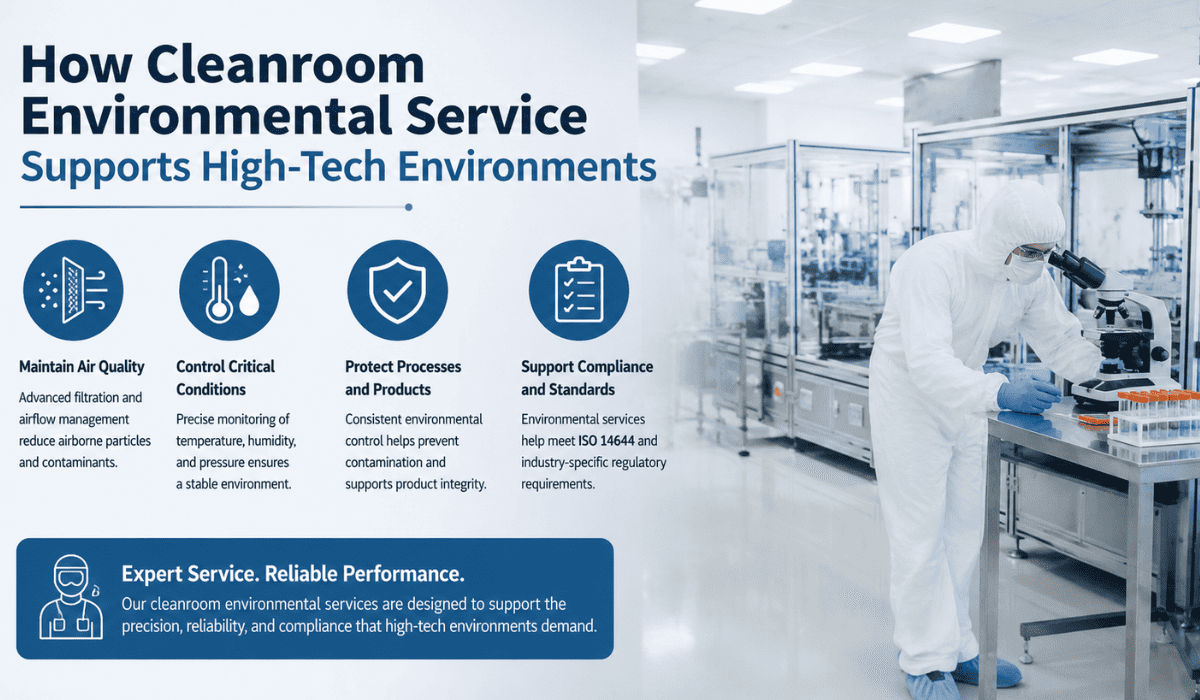
A cleanroom can be designed to meet the required ISO classification, equipped with validated filtration systems, and operated by trained personnel, yet contamination events can still occur.
These events can affect product quality, interrupt production, and create significant operational challenges.
The issue is often not the cleanroom structure itself but how well the environment is maintained over time.
High-tech industries such as semiconductor manufacturing, electronics, aerospace, EV battery production, optical manufacturing, and medical device production depend on extremely stable environmental conditions.
Small changes, including increased particle levels, humidity variations, airflow disruption, or differential pressure fluctuations, can affect sensitive processes without immediate warning.
A cleanroom environmental service helps facilities continuously monitor these changes and maintain control over their controlled environments.
Rather than being limited to periodic certification testing, it provides ongoing data that allows manufacturers to identify trends, investigate deviations, and take corrective action before environmental conditions impact production.
What Is a Cleanroom Environmental Service?
A cleanroom environmental service is a structured program designed to monitor and evaluate whether a controlled environment continues to operate within its defined requirements.
It combines environmental monitoring, testing, data analysis, and documented response procedures to provide a clear understanding of cleanroom performance during daily operations.
While cleanroom certification testing verifies whether a facility meets ISO requirements at a specific point in time, environmental monitoring provides continued visibility between certification events.
ISO 14644-1 defines cleanroom classifications based on airborne particle concentrations, while ISO 14644-2 provides guidance for developing monitoring plans that demonstrate ongoing cleanroom performance.
A certification test may confirm that a cleanroom meets requirements on the day of testing.
However, a properly designed environmental service helps determine whether those conditions remain stable during normal production, maintenance activities, and operational changes.
The scope of a cleanroom environmental service should be based on the facility’s specific needs, including its classification, manufacturing process, equipment layout, product sensitivity, and contamination risks.
A monitoring approach designed for another facility may not accurately reflect the risks present in a different environment.
Particle Monitoring: Understanding More Than Particle Counts
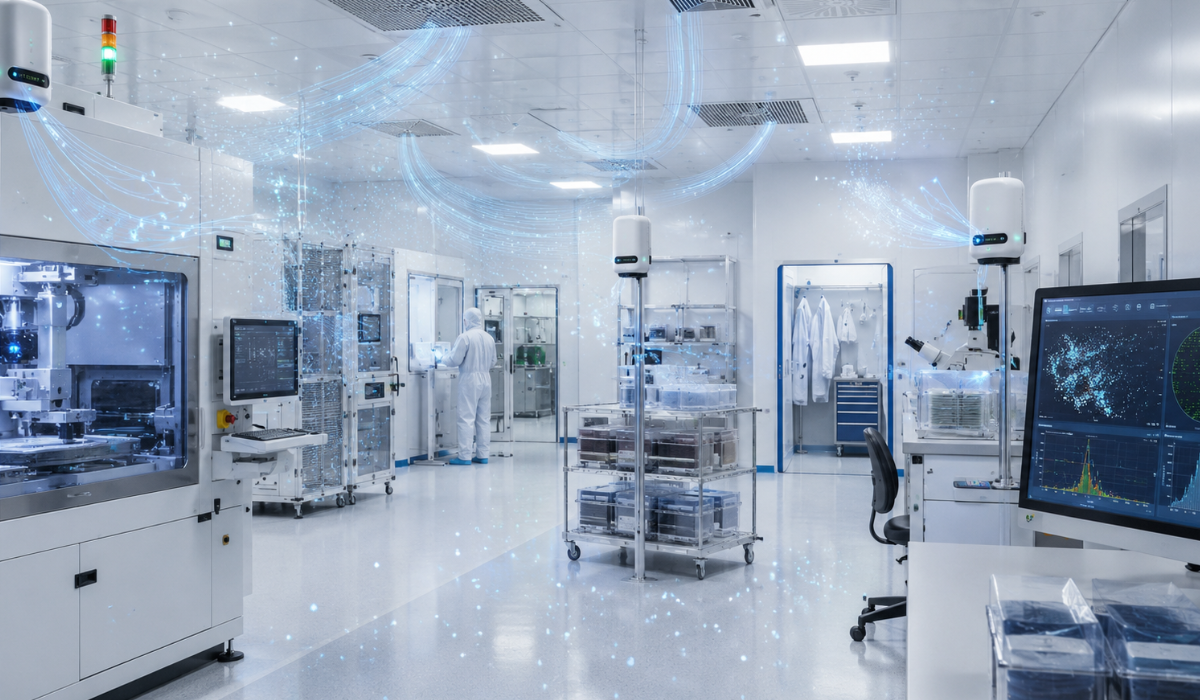
Airborne particle monitoring is a fundamental part of cleanroom environmental control.
Particles can enter controlled spaces through personnel movement, packaging materials, equipment operation, maintenance work, and material transfers.
However, particle monitoring only measures the concentration and size of airborne particles. It does not determine whether particles are metallic, biological, fibrous, or chemically active.
A cleanroom meeting particle limits does not necessarily mean every contamination risk has been eliminated.
It only confirms that airborne particle concentrations at measured locations are within the specified limits at that particular time.
For this reason, monitoring location and timing are critical. A sensor placed near an air supply may show acceptable conditions while a nearby production tool, transfer area, or operator workstation experiences different environmental conditions.
Effective particle monitoring considers airflow patterns, equipment placement, production activities, and room usage.
Environmental data must also be interpreted alongside operational events.
Measurements collected during routine manufacturing may not represent conditions during maintenance, equipment installation, or material handling activities.
Temperature and Humidity Monitoring
Temperature and humidity stability are essential in many high-tech manufacturing environments.
A single sensor may not accurately represent conditions throughout an entire cleanroom because equipment, lighting systems, personnel activity, and airflow distribution can create local variations.
Temperature and humidity mapping evaluates conditions across multiple areas to determine whether environmental differences could affect the manufacturing process.
These studies should reflect actual operating conditions. A cleanroom without active equipment or personnel may behave differently from the same space operating at full production capacity.
The results of temperature and humidity mapping can help facilities identify areas requiring improved airflow distribution, sensor relocation, or revised operating limits.
Acceptable environmental ranges should be based on product requirements, equipment specifications, and process validation data rather than general assumptions.
Different industries may require different environmental controls depending on the sensitivity of their processes.
Differential Pressure and Airflow Evaluation
Differential pressure plays an important role in controlling how air moves between cleanroom spaces.
Maintaining the correct pressure relationship helps prevent unwanted contamination from entering sensitive areas or, in containment applications, prevents materials from escaping controlled zones.
A change in differential pressure does not automatically explain the cause of an environmental deviation.
Possible reasons may include airflow imbalance, filter loading, HVAC issues, open doors, blocked return air pathways, or leakage within the room structure.
Airflow evaluation provides a deeper understanding of cleanroom performance by examining how air moves throughout the space.
Testing may include airflow velocity measurements, directional airflow checks, recovery studies, or smoke testing.
This evaluation becomes especially important after installing large production equipment, as machinery can alter airflow patterns, create turbulence, or affect areas that require consistent contamination control.
Electrostatic Discharge Control in Cleanroom Environments
Electrostatic discharge (ESD) is a significant concern in semiconductor, electronics, and battery manufacturing because uncontrolled static can damage sensitive components, attract particles, and affect precision processes.
Unlike airborne contamination, ESD risks cannot be detected through particle monitoring or controlled through filtration systems.
Managing ESD requires an integrated approach involving suitable flooring, grounded work surfaces, appropriate tools, static-control garments, and validated handling procedures.
A cleanroom environmental service can support ESD management by ensuring environmental conditions remain suitable for static-control measures.
Humidity levels, materials, garments, and operating procedures all influence ESD performance and should be evaluated as part of the overall contamination-control strategy.
Designing an Effective Environmental Monitoring Plan
The effectiveness of a monitoring program depends on how well it reflects real operational risks.
A useful environmental monitoring plan should identify critical areas, sensitive processes, and locations where environmental changes could affect product quality. Monitoring points should be selected based on risk rather than convenience.
The program should define how frequently measurements are taken, how results are reviewed, what conditions trigger investigation, and how deviations are documented.
Continuous monitoring may be necessary in areas where environmental changes can quickly affect production, while periodic monitoring may be sufficient for stable environments.
The goal is not simply to collect environmental data but to collect meaningful information that supports decision-making.
Alarm Response and Environmental Investigation
An environmental alarm should trigger investigation rather than an immediate assumption that the cleanroom has failed.
The first step is confirming whether the monitoring system is operating correctly.
Sensor issues, communication failures, power interruptions, or temporary operational activities can sometimes create unexpected readings.
If a genuine deviation is identified, the investigation should review relevant information, including production records, maintenance activities, cleaning schedules, equipment changes, and environmental trends.
A proper investigation should document what occurred, what information was reviewed, the likely cause, corrective actions taken, and any follow-up testing required.
Calibration, Cleaning, and Change Control
Environmental monitoring data is only reliable when measurement equipment is properly maintained and calibrated.
Facilities should establish calibration practices based on equipment requirements, previous performance, and the impact inaccurate readings could have on production decisions.
Cleaning processes also influence cleanroom performance. Cleaning materials, chemicals, and methods should be evaluated to ensure they do not introduce additional contamination risks.
Change control is equally important. Any modification to equipment, HVAC systems, room layout, production processes, or cleanroom classification should trigger a review of the monitoring programme to confirm that existing measurement locations remain appropriate.
Conclusion
A cleanroom environmental service provides high-tech manufacturers with a structured approach to maintaining environmental control beyond initial certification.
Through continuous monitoring, accurate measurement, data interpretation, and documented response procedures, facilities can identify environmental changes before they affect product quality or production efficiency.
For industries where even minor environmental variations can create significant consequences, a well-designed cleanroom environmental service is not simply a compliance activity.
It is an essential tool for maintaining reliable, consistent, and controlled manufacturing environments.
Need a Reliable Cleanroom Environmental Service?
Maintaining a controlled environment requires more than periodic certification.
A tailored cleanroom environmental service helps you monitor critical conditions, identify potential issues early, and support consistent performance across your operations.
Whether you’re managing a semiconductor, electronics, aerospace, battery, or medical manufacturing facility, our team at UltraPure Technology can help you develop an environmental monitoring programme that aligns with your process requirements and operational goals.
Contact us today to discuss your cleanroom monitoring needs and discover how a customised environmental service can help improve contamination control, operational reliability, and long-term compliance.
FAQs
Where should cleanroom environmental sensors be installed?
Sensors should be installed in locations that represent critical process areas and actual operating conditions. Placement should consider airflow patterns, equipment location, personnel activity, and contamination risks.
What can cause a cleanroom environmental alarm?
Environmental alarms may occur due to sensor problems, communication failures, power interruptions, airflow changes, humidity fluctuations, or temporary operational events. Each alarm should be investigated before determining the cause.
How often should a cleanroom environmental monitoring plan be reviewed?
The monitoring plan should be reviewed regularly and whenever significant changes occur, such as equipment relocation, HVAC modifications, process changes, or cleanroom reconfiguration.
What is the difference between cleanroom certification and environmental monitoring?
Cleanroom certification confirms performance at a specific point in time, while environmental monitoring provides ongoing evidence that the cleanroom continues to operate within required conditions.