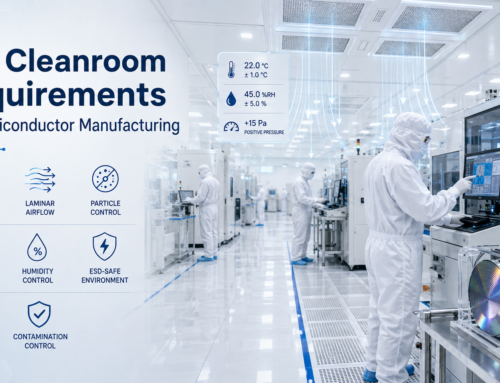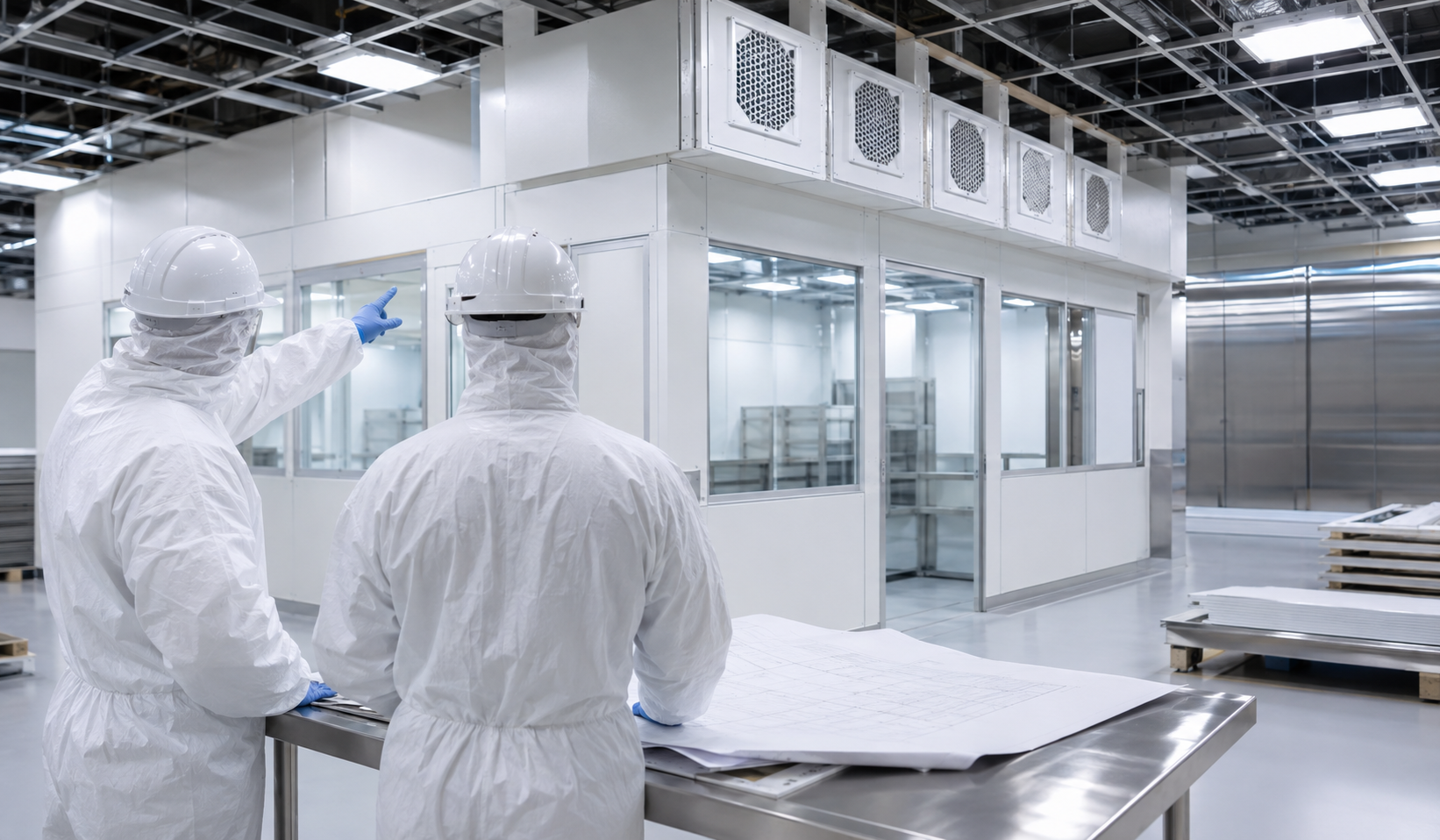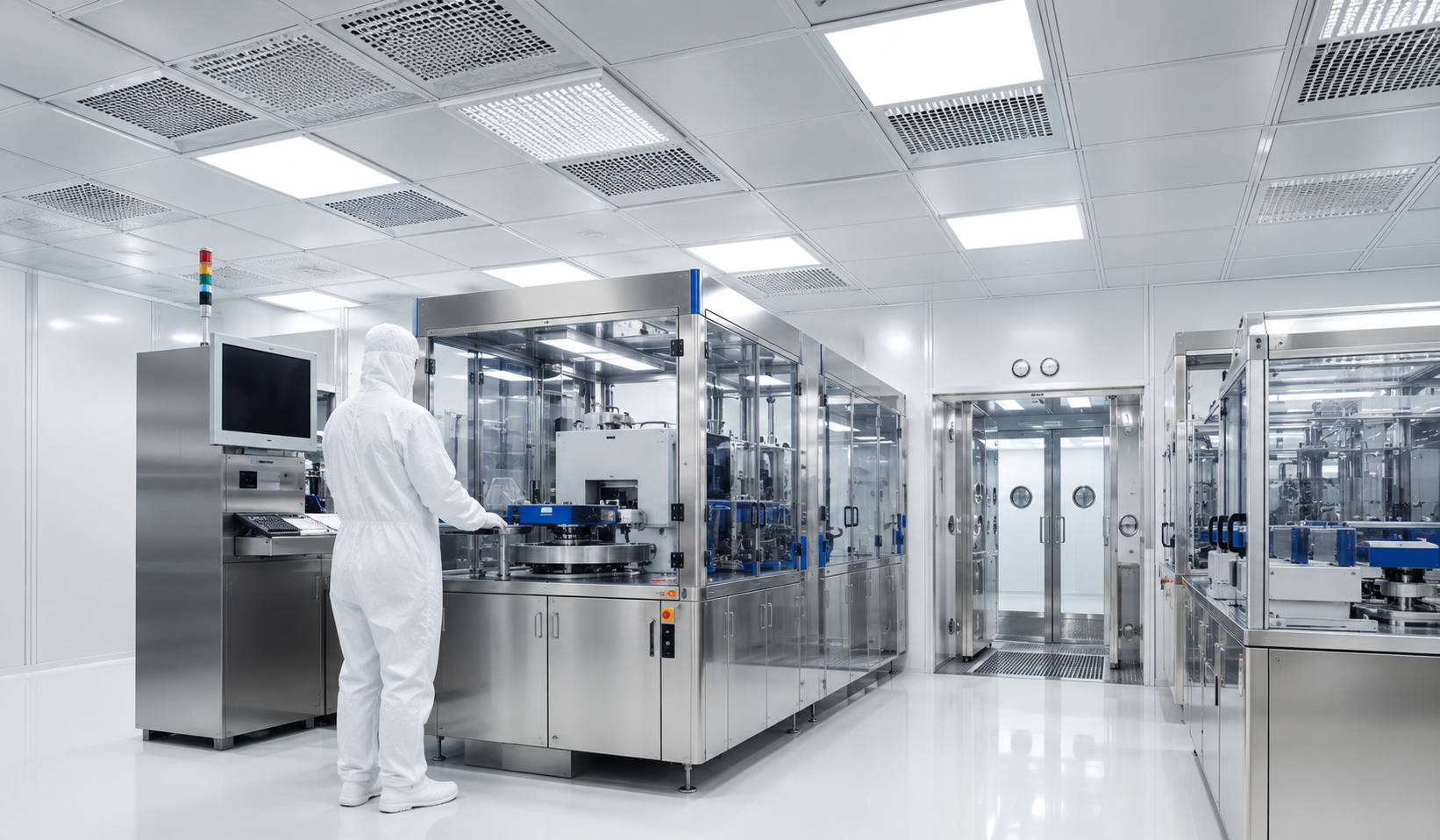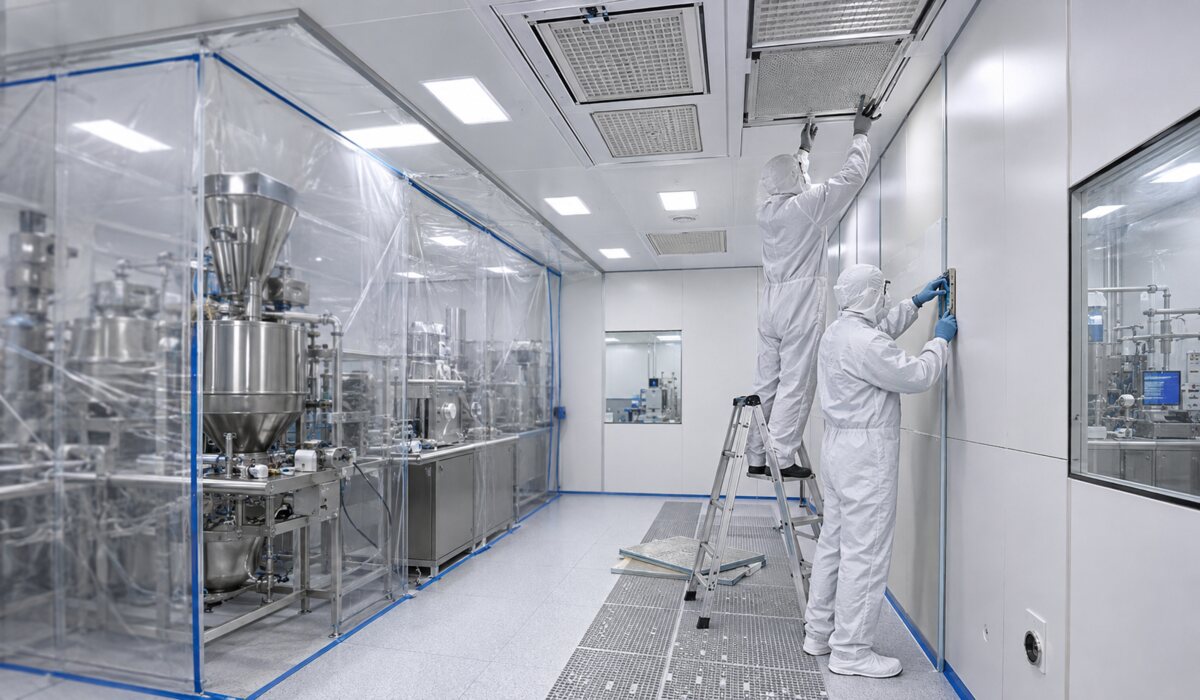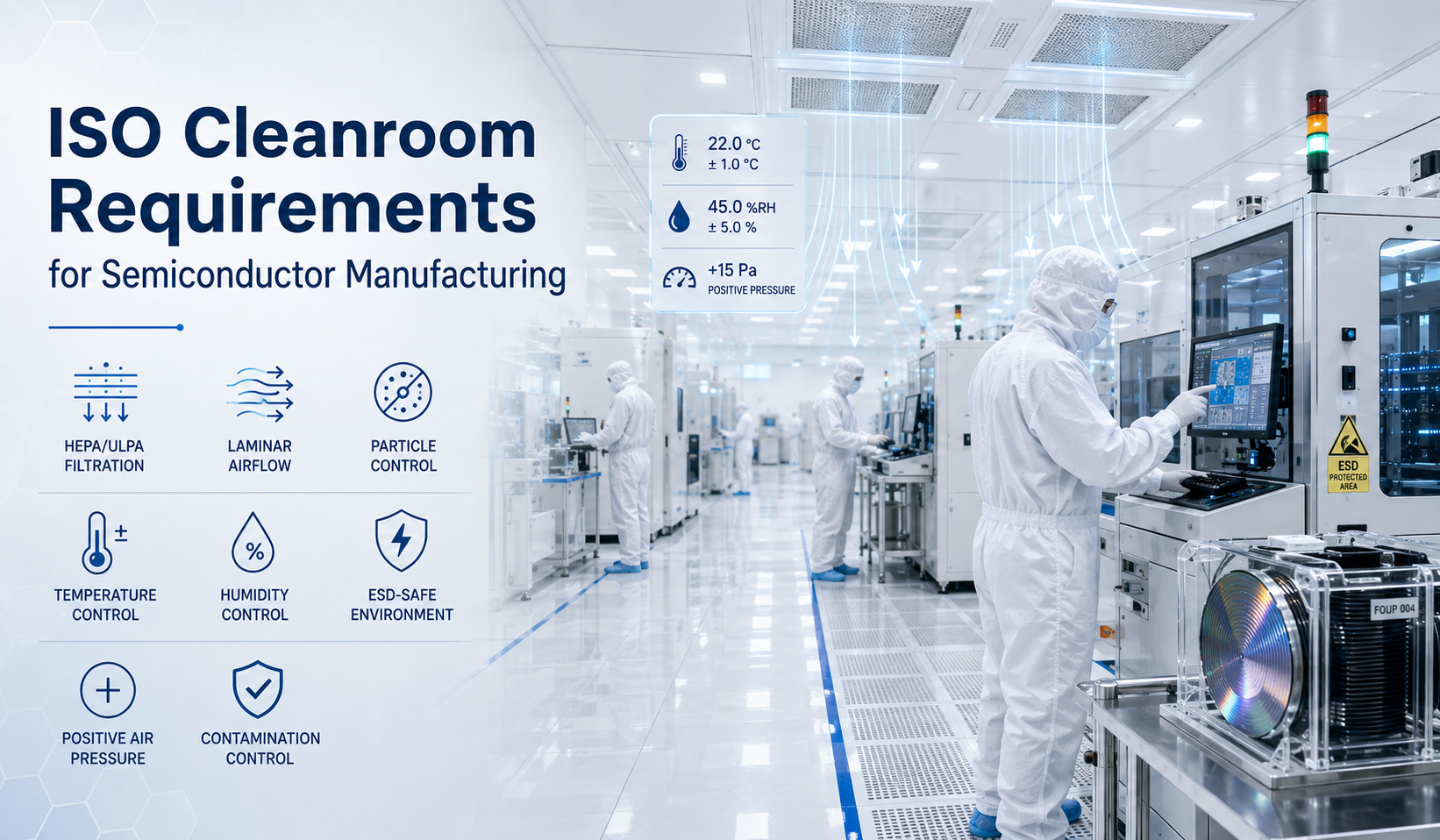
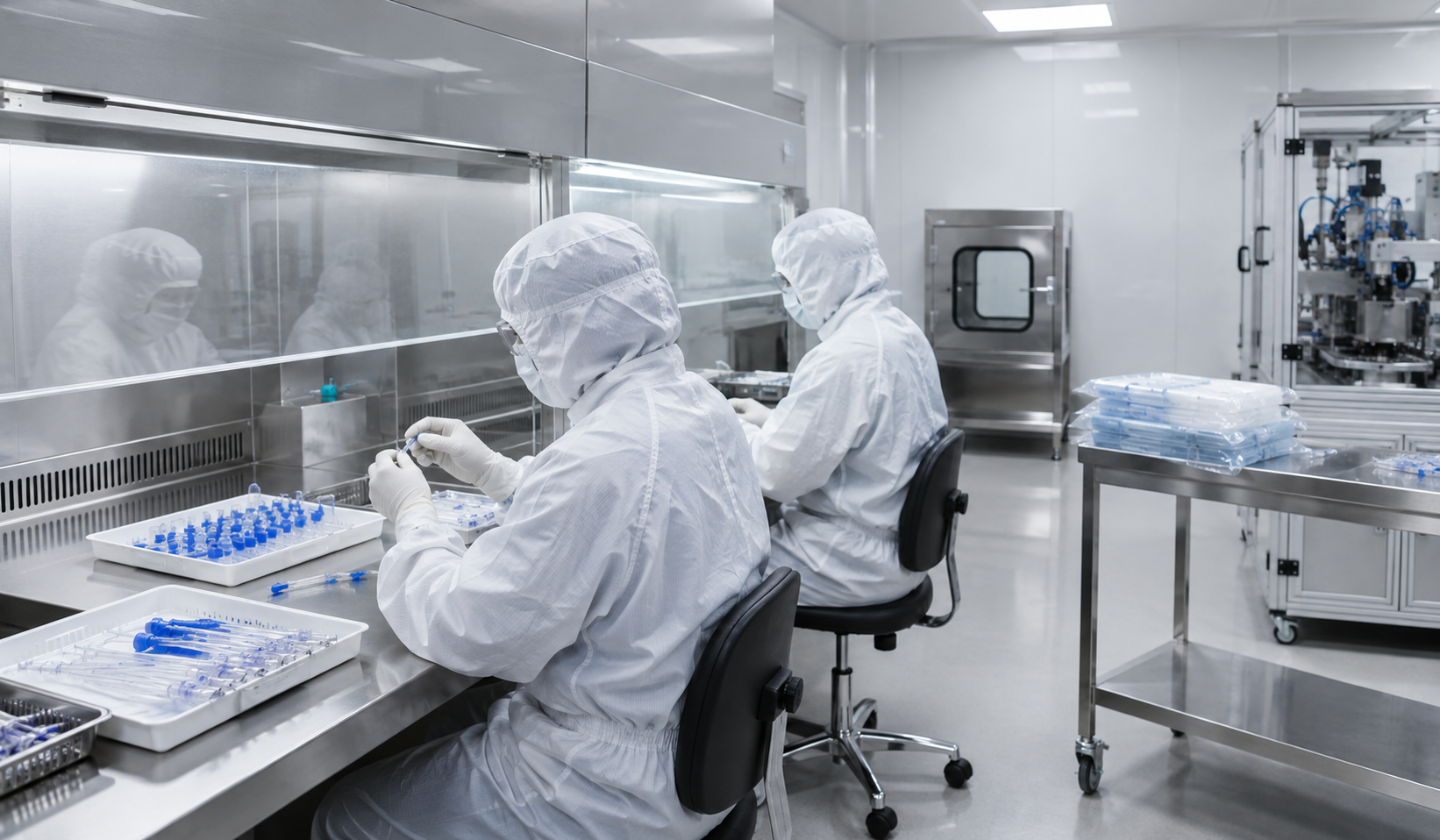
A medical device cleanroom is designed to control airborne particles, humidity, temperature, microbes, and other tiny living things to keep the manufacturing environment safe.
According to ISO 14644-1 and the FDA, rooms must be classified between ISO Class 5 and ISO Class 8 to meet the requirements for medical device cleanrooms and to avoid risks.
What is a Cleanroom and Why It Matters for Medical Devices?
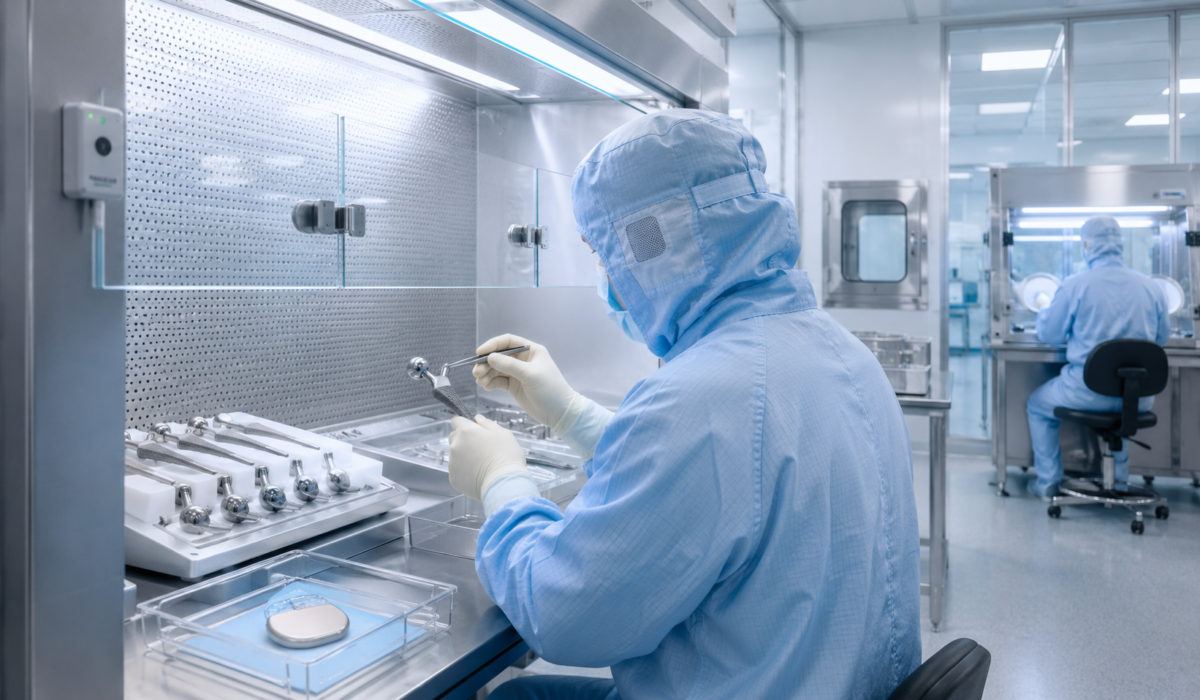
A cleanroom is a room where air quality is checked before the manufacturing of medical devices.
Whether it is a matter of performing chest implantation, bone surgery, or other treatment, it is essential to ensure that the devices used inside the human body are completely sterilized.
There is no contact with airborne particles because even a single particle of 0.5 microns in size can cause infection in the human body, fail the treatment, and make it difficult for a foreign body to respond as expected.
This is why it is essential to meet cleanroom requirements for medical devices and to follow the FDA guidelines for medical cleanrooms.
At Ultrapure Technology, we help medical device manufacturers plan controlled environments from initial design and construction through testing, certification, and ongoing monitoring.
We also help clients understand cleanroom classifications and establish environmental controls suited to their manufacturing processes.
ISO Cleanroom Classification Levels for Medical Device Manufacturing
ISO 14644-1 classifies cleanrooms according to the maximum allowable concentration of airborne particles per cubic meter. Medical device manufacturers may use environments ranging from ISO Class 5 to ISO Class 9, depending on the product, manufacturing process, and contamination risks.
| ISO class | Former Federal Standard | Maximum particles/m³ at ≥0.5 µm | Typical ACH range* | Potential medical device activities | Examples |
| ISO Clas
s 5 |
Class 100 | 3,520 | 240–600 | Critical open processing and highly contamination-sensitive operations | Implantable components, heart valves, and certain orthopedic devices |
| ISO Class 6 | Class 1,000 | 35,200 | 150–240 | Sensitive device production and background areas supporting ISO Class 5 zones | Stents, intraocular lenses, and coated implant components |
| ISO Class 7 | Class 10,000 | 352,000 | 30–60 | Controlled assembly and processing of contamination-sensitive products | Catheters, surgical instruments, gowns, and wound-care products |
| ISO Class 8 | Class 100,000 | 3,520,000 | 10–25 | General device assembly, packaging, and pre-sterilization operations | Syringes, oxygen masks, and monitoring accessories |
| ISO Class 9 | No direct equivalent | 35,200,000 | 10–12 | Supporting operations involving less-sensitive components | Non-sterile packaging materials and components awaiting additional processing |
Air-change ranges are general design estimates, not requirements established by ISO 14644-1. Medical device classifications also do not directly correspond to specific ISO classes.
Manufacturers should select and validate the environment based on a documented assessment of the device, process, and contamination risks.
Which ISO Class Does a Medical Device Facility Need?
There is no universal cleanroom classification for all medical device manufacturing.
A facility may contain several rooms with different classifications because the contamination risk changes from one production stage to another.
The selection process should consider:
- Whether the device or component is exposed to the room environment
- Whether the manufacturing process is open, closed, or contained
- The device’s intended use and patient-contact risk
- The type of contamination that could affect product quality
- Whether the device will be terminally sterilized
- The required bioburden or particulate limits
- The sensitivity of surfaces, coatings, electronics, or optical components
- Sterile-barrier packaging and sealing requirements
- Personnel and material movement
- Customer, regulatory, and quality-system requirements
For example, an exposed and contamination-sensitive operation may require stricter controls than final packaging or component preparation.
Localized ISO Class 5 protection may also be created within an ISO Class 7 or ISO Class 8 background room when only one process area needs a more controlled environment.
Do FDA Device Classes Decide the Cleanroom Class?
FDA device classifications and ISO cleanroom classifications measure different things.
FDA Class I, II, and III classifications generally reflect a medical device’s regulatory controls and level of risk. ISO Classes 1 through 9 describe airborne particle concentrations inside a controlled environment.
A Class III device does not automatically require an ISO Class 5 cleanroom. Similarly, an ISO Class 8 environment is not limited to Class I or non-sterile devices.
The appropriate cleanroom class depends on how contamination could affect the product and manufacturing process not solely on the device’s regulatory category.
Under the FDA’s Quality Management System Regulation, which became effective on February 2, 2026, manufacturers must establish an appropriate quality management system for their operations.
Where environmental conditions could affect device quality, those conditions must be suitably controlled and supported by documented procedures.
What Are the Main Medical Device Cleanroom Design Requirements?
ISO 14644-1 establishes a method for classifying air cleanliness by particle concentration, but it does not prescribe one design for every medical device cleanroom. FDA requirements also focus on controlling environmental conditions that could adversely affect product quality.
Therefore, the cleanroom should be designed around the device, manufacturing process, contamination risks, personnel movement, and applicable quality requirements.
Cleanable Construction Materials
Walls, ceilings, floors, doors, and work surfaces should be smooth, durable, low-shedding, and compatible with the facility’s cleaning agents.
Common features may include:
- Epoxy, sheet vinyl, or other cleanable flooring
- Sealed joints and service penetrations
- Coved floor-to-wall transitions
- Flush doors, windows, lighting, and hardware
- Cleanable wall and ceiling systems
- Corrosion- and chemical-resistant finishes
Materials should be selected according to expected wear, cleaning methods, chemical exposure, outgassing limits, moisture, and electrostatic-control requirements. ISO 14644 does not require one specific flooring or wall material.
Suitable Airflow and Filtration
The airflow system must supply enough filtered air to achieve and maintain the specified cleanliness level during actual operations.
Depending on the process, the design may use:
- Unidirectional airflow for critical work zones
- Non-unidirectional airflow for less critical rooms
- Terminal HEPA or ULPA filters
- Low-level or high-level return-air locations
- Localized clean-air devices or mini-environments
- Single-pass or recirculating airflow
ISO Class 5 areas often use unidirectional airflow, but ISO 14644-1 does not mandate a universal ceiling-filter coverage percentage. The design must be qualified through particle-count testing, airflow visualization, velocity measurements, and other relevant tests.
Pressure Control Between Rooms
A positive-pressure cascade is commonly used when the goal is to prevent less-clean air from entering a more controlled area. The cleaner room is generally maintained at a higher pressure than the adjoining space.
Negative pressure may be necessary when the process involves hazardous, sensitizing, or biologically active materials that must be contained. Pressure direction and differentials should therefore be based on the contamination-control objective rather than a universal requirement of 10–15 pascals.
Controlled Entry and Gowning Areas
The entry sequence should allow employees to put on cleanroom garments without contaminating the clean side of the gowning area. The required layout depends on the room classification, gowning procedure, and manufacturing risk.
Entry controls may include:
- Staged gowning areas
- Personnel airlocks
- Material airlocks
- Interlocked doors
- Pass-through chambers
- Separate personnel and material routes
- Defined clean and less-clean zones
Air showers may support contamination control in some facilities, but they are not automatically required for ISO Class 5 or ISO Class 6 cleanrooms.
Temperature and Humidity Control
Temperature and relative humidity should be maintained within limits established for product quality, employee comfort, equipment performance, and process stability.
A range such as 18–22°C and 30–60% relative humidity may suit some operations, but it is not a universal ISO 14644 requirement. Certain devices, materials, adhesives, coatings, and electronic components may require different conditions.
Critical environmental parameters should be monitored, recorded, and managed according to approved procedures. Automated alarms may be used when an excursion could affect the product or validated process.
Contamination-Control Technology
Automation can reduce direct human interaction with exposed products and improve process consistency. Depending on the application, a facility may use:
- Robotic assembly equipment
- Automated material-transfer systems
- Restricted-access enclosures
- Continuous particle monitoring
- Electronic environmental-monitoring systems
- Automated alerts and trend analysis
Automation does not eliminate the need for cleaning, maintenance, process validation, personnel training, or environmental qualification. Any automated system affecting product quality should be appropriately qualified and controlled.
Documented Cleaning Procedures
Facilities should establish cleaning procedures suited to the room classification, process, and identified contamination risks. These procedures should define:
- Approved cleaning and disinfecting agents
- Required concentrations and contact times
- Cleaning techniques and direction
- Cleaning frequency
- Dedicated tools and supplies
- Personnel responsibilities
- Documentation and response to deviations
Sterile or aseptic processes may require disinfectant rotation or periodic use of a sporicidal agent. Such practices are not automatically necessary for various medical device cleanrooms.
Cleaning records should be retained within the manufacturer’s quality management system. They should not automatically be described as part of the Device History Record unless the company’s procedures require them to be included there.
Frequently Asked Questions
Does ISO 14644-1 Specify Air Changes per Hour?
ISO 14644-1 classifies cleanrooms by airborne particle concentration rather than by a fixed number of air changes per hour. The appropriate airflow rate depends on the room layout, process, equipment, personnel, particle load, and recovery-time target.
Can Cleanrooms in the Same ISO Class Use Different Air-Change Rates?
Cleanrooms with the same ISO classification may operate at different air-change rates. Each facility must demonstrate through particle-count testing that its airflow system maintains the specified cleanliness level under defined operating conditions.
Does Increasing the Air-Change Rate Improve Cleanliness?
Higher airflow can help dilute and remove airborne particles, but it does not guarantee compliance. Filter performance, airflow distribution, room construction, cleaning, personnel practices, and process-generated contamination also affect cleanroom performance.
Why Does Over-Specifying a Cleanroom Increase Costs?
A stricter classification may require additional filter coverage, larger air-handling equipment, greater cooling capacity, tighter construction, more restrictive gowning, and increased monitoring. These requirements can raise construction, energy, maintenance, and certification expenses.
How Should Cost Influence Cleanroom Classification?
Cost should be evaluated after identifying the environmental controls needed to protect the device and manufacturing process. Lifecycle comparisons can help manufacturers select a compliant design without adding controls that do not provide meaningful risk reduction.
How Do Manufacturers Select an Appropriate ISO Class?
Selection begins with an assessment of the device, intended use, manufacturing activities, product exposure, contamination sensitivity, sterilization method, personnel load, and applicable quality requirements. The chosen class should match the actual process risks.
What Should a Cleanroom Classification Risk Assessment Cover?
The assessment should identify relevant contaminants, explain how they could affect the device, justify the selected cleanliness level, and establish requirements for monitoring, cleaning, maintenance, testing, and responses to environmental excursions.
What Controls Are Needed Beyond ISO Classification?
A complete contamination-control program may include qualified HVAC systems, cleanable finishes, validated processes, trained personnel, gowning procedures, environmental monitoring, scheduled cleaning, preventive maintenance, and periodic cleanroom testing.