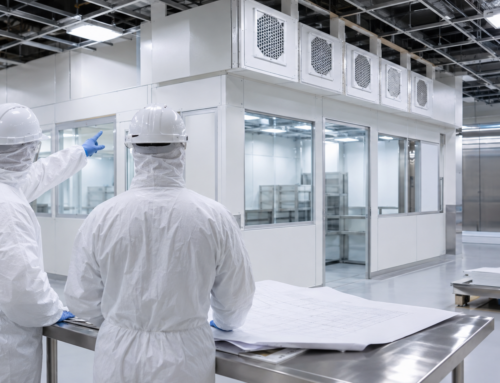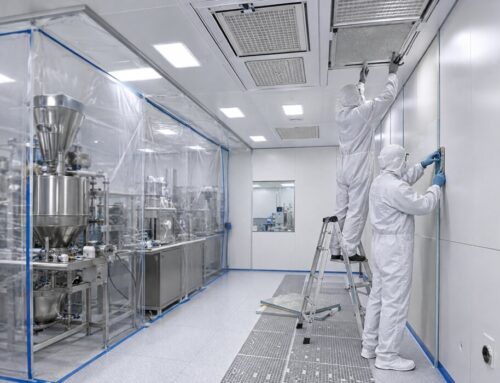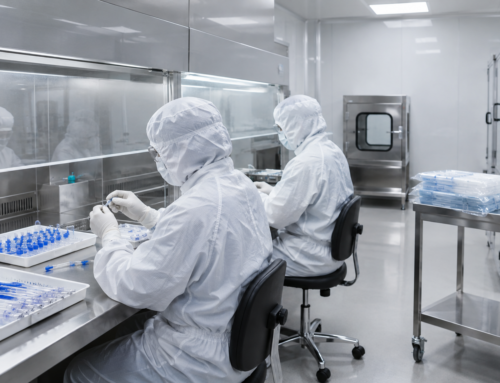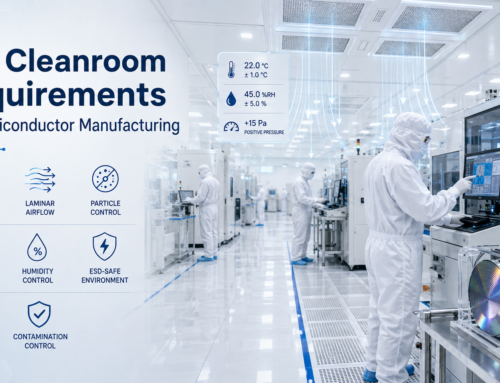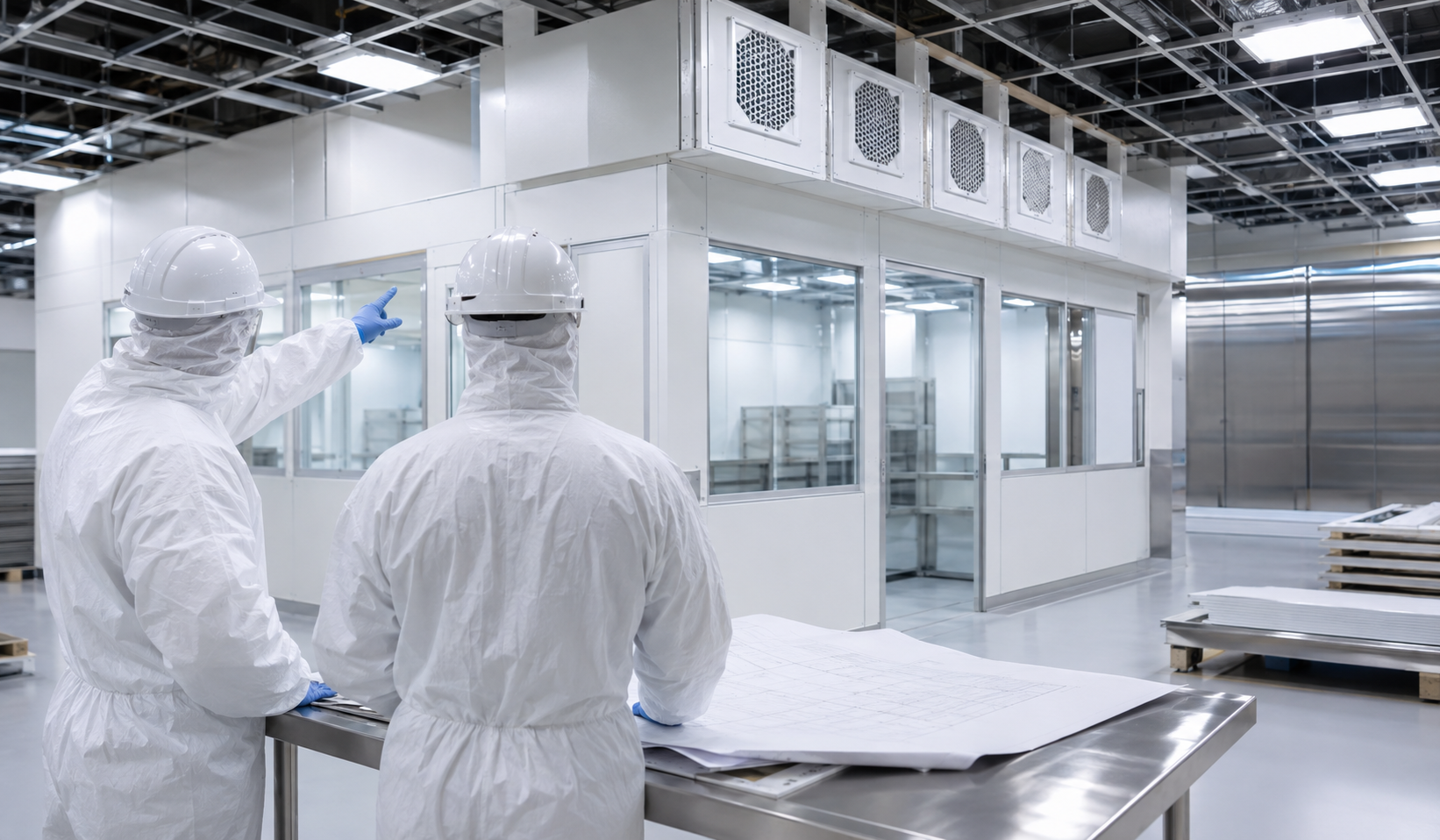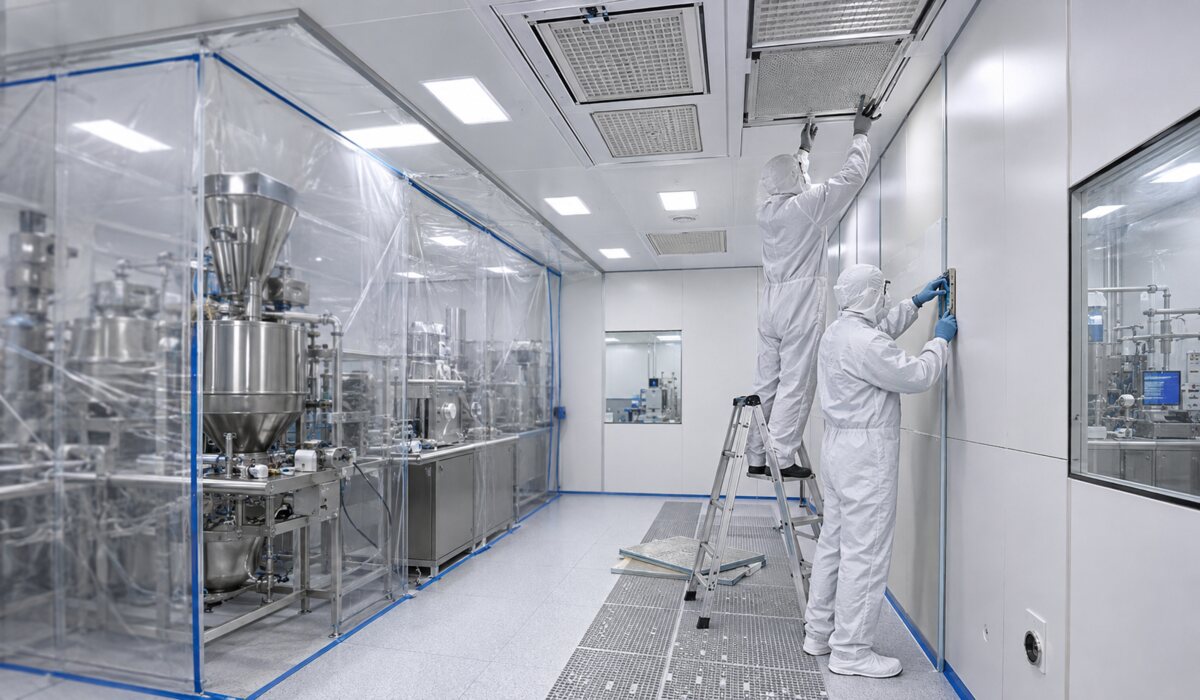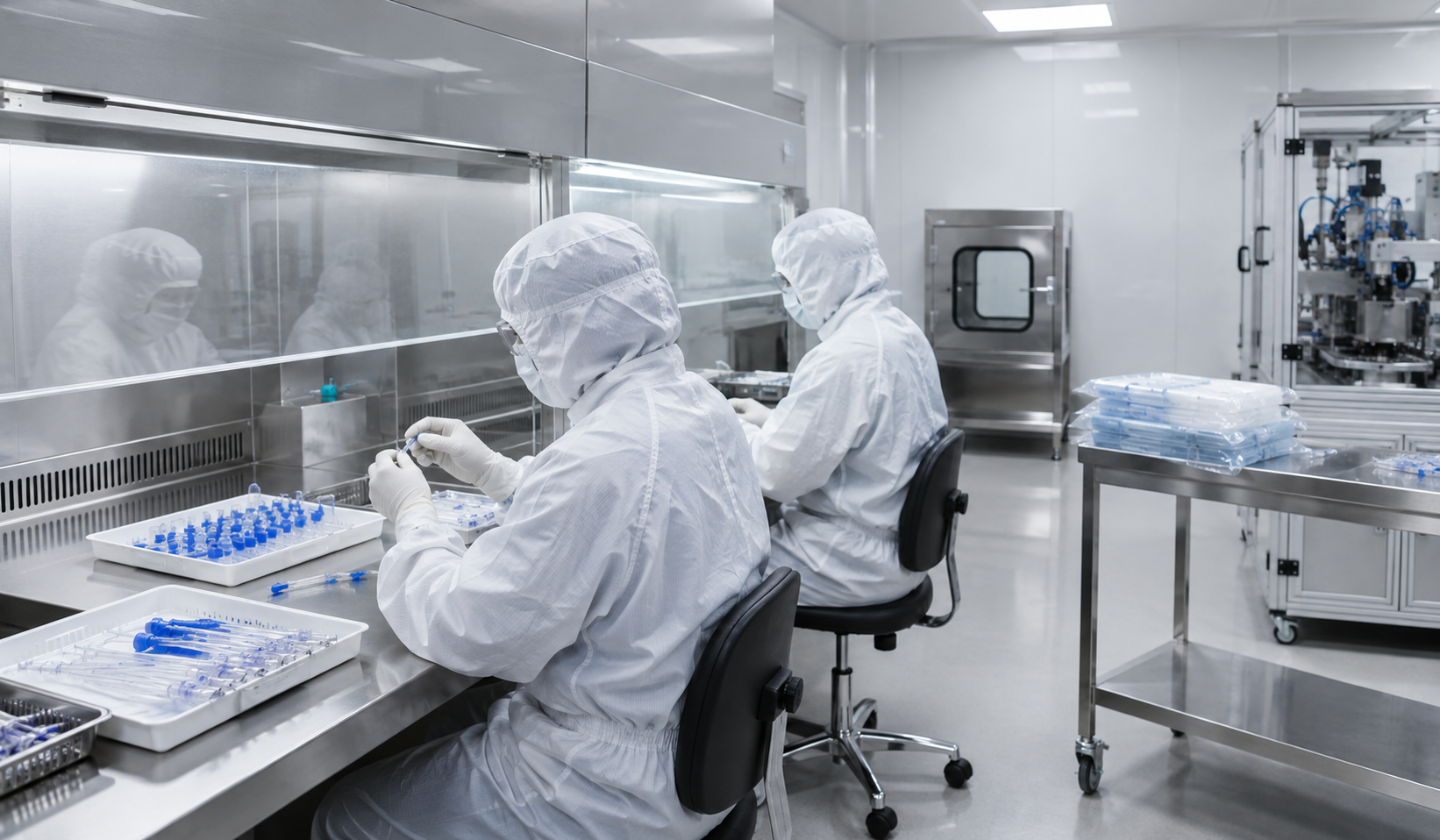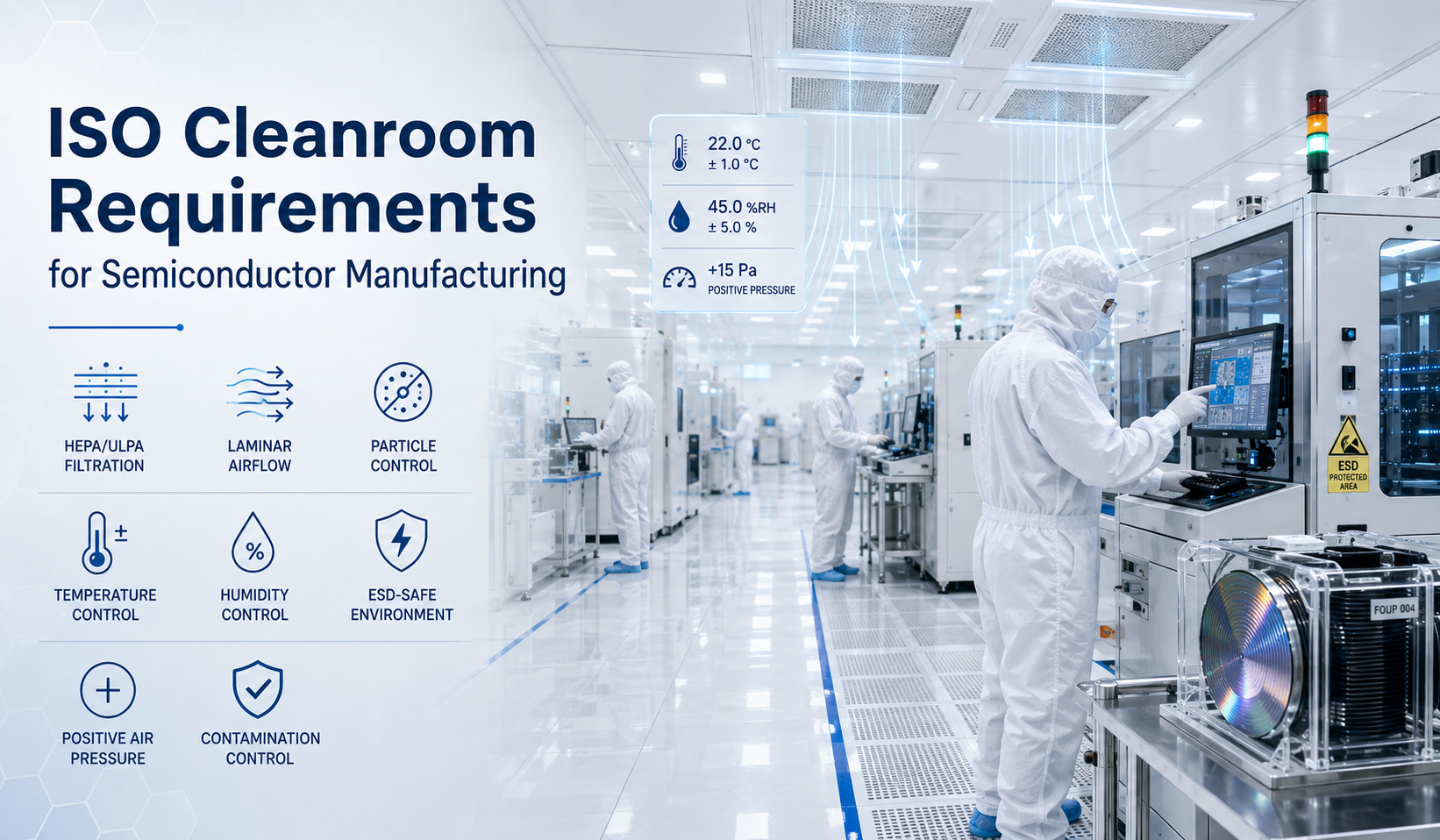
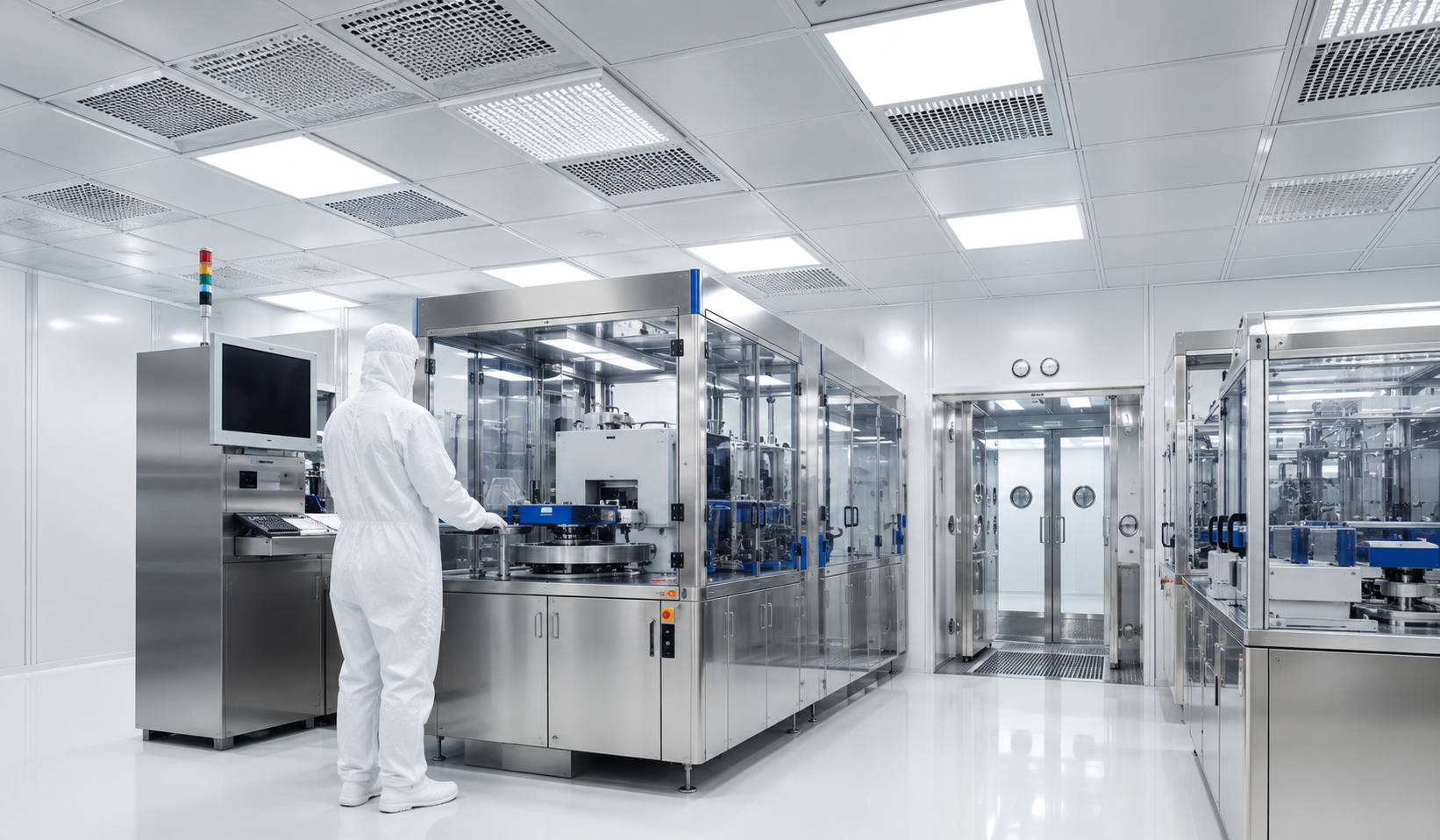
An ISO Class 4 cleanroom is a highly controlled, ultra-clean environment used when tiny airborne particles could affect a product, measurement, or manufacturing process.
Common applications include semiconductor manufacturing, nanotechnology, precision optics, photonics, aerospace, and certain medical-device processes.
Under ISO 14644-1, an ISO Class 4 cleanroom allows no more than 10,000 particles ≥0.1 µm, 2,370 ≥0.2 µm, 1,020 ≥0.3 µm, 352 ≥0.5 µm, and 83 ≥1.0 µm per cubic meter of air.
At the 0.5 µm particle size, ISO Class 4 allows 352 particles per cubic meter, compared with 3,520 for an ISO Class 5 cleanroom. This makes the Class 4 limit 10 times stricter.
The classification mainly tells us how clean the air must be. Other factors, such as temperature, humidity, airflow, pressure, equipment, and cleaning procedures, depend on the facility’s specific process and requirements.
How Clean Is an ISO Class 4 Cleanroom?
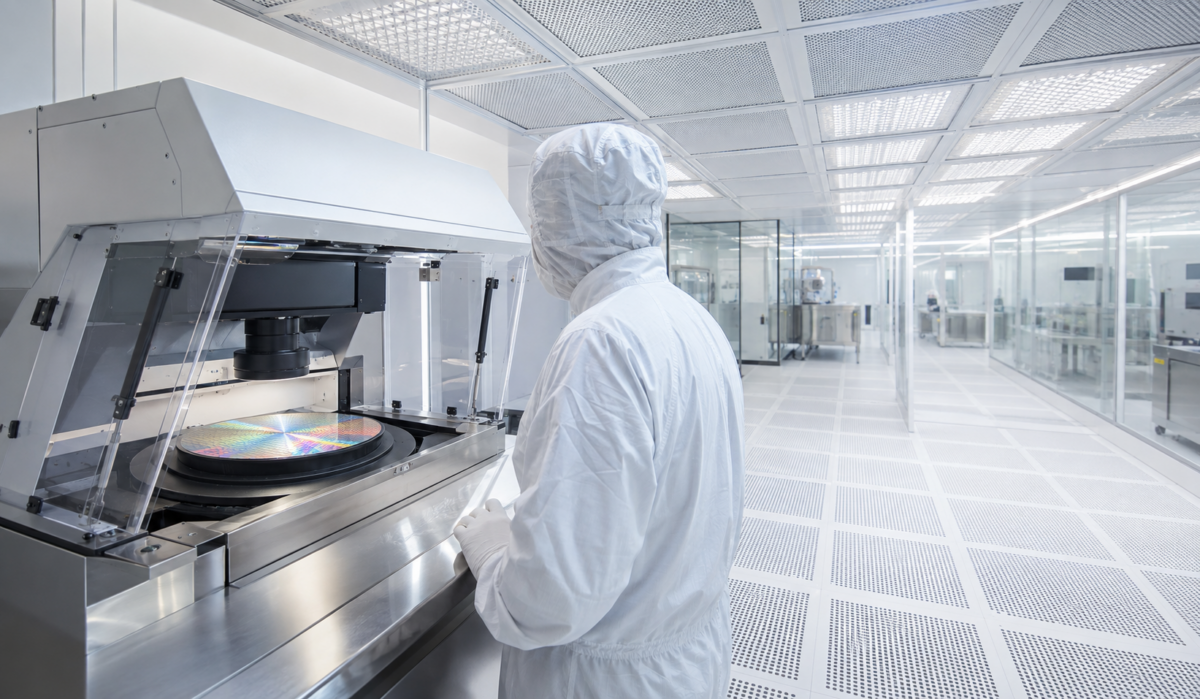
In ISO 14644-1, lower class numbers mean stricter particle limits. ISO Class 4 is therefore cleaner than Classes 5 through 9 but less restrictive than Classes 1 through 3.
The ISO Class 4 particle limits are:
| Particle Size | Maximum particles per m³ |
| ≥0.1 µm | 10,000 |
| ≥0.2 µm | 2,370 |
| ≥0.3 µm | 1,020 |
| ≥0.5 µm | 352 |
| ≥1.0 µm | 83 |
A micrometer (µm) is one-millionth of a meter. For perspective, a human hair is roughly 100 µm wide, while ISO Class 4 controls particles as small as 0.1 µm.
These limits apply to nonviable airborne particles. ISO 14644-1 particle classification does not determine whether a particle is biological, chemical, or otherwise hazardous.
Is ISO Class 4 the Same as Class 10?
ISO Class 4 is commonly compared with Class 10 under the discontinued Federal Standard 209E.
However, the two systems should not be treated as completely interchangeable.
ISO 14644-1 measures particle concentrations per cubic meter, while Federal Standard 209E used particles per cubic foot.
Technical specifications should therefore identify the applicable standard and testing requirements rather than relying only on the term “Class 10.”
Does Your Process Need ISO Class 4 Conditions?
Not every facility in a contamination-sensitive industry needs an ISO Class 4 cleanroom.
The required classification should be based on the process, product sensitivity, particle risk, and contamination consequences.
ISO Class 4 may be appropriate when:
- A sensitive surface remains exposed during manufacturing or assembly.
- Particles could damage a product or interfere with measurements.
- Manufacturing data shows a connection between contamination and defects.
- Customer specifications or regulations require a specific cleanliness level.
- A less restrictive cleanroom cannot provide adequate protection.
An entire room may not need to be ISO Class 4 if the sensitive process is enclosed or protected by a mini-environment, isolator, glovebox, or clean-air hood.
A contamination-control risk assessment should identify the critical particle sizes, exposed process steps, contamination sources, and potential consequences before selecting the cleanroom classification.
Which ISO Standards Apply to Class 4 Cleanrooms?
ISO 14644-1 establishes airborne particle concentration limits and provides the classification method. Other parts of the ISO 14644 series address different aspects of cleanroom operation.
- ISO 14644-1: Air cleanliness classification by particle concentration.
- ISO 14644-2: Monitoring cleanroom performance.
- ISO 14644-3: Cleanroom test methods.
- ISO 14644-4: Design, construction, and start-up.
- ISO 14644-5: Cleanroom operations.
Together, these standards help address the design, testing, monitoring, and operation of controlled environments.
Importantly, ISO Class 4 is not a complete construction specification. ISO 14644-1 establishes particle limits, but it does not require every facility to use the same HVAC system, filter type, room layout, pressure differential, or air-change rate.
What Does ISO Require, and What Depends on the Process?
Some requirements are defined by ISO 14644-1, while other design decisions depend on the facility.
| Factor | How it is determined |
| Airborne particle limits | ISO 14644-1 |
| Classification method | ISO 14644-1 |
| Filter type | Facility design and particle-control requirements |
| Air changes | Room size, contamination load, and recovery needs |
| Pressure differential | Product protection and room layout |
| Temperature and humidity | Product, equipment, and process requirements |
| Gowning | Personnel and contamination risks |
| Microbial limits | Applicable industry and regulatory requirements |
Does ISO Class 4 Require HEPA or ULPA Filters?
ISO 14644-1 does not prescribe a specific filter type. HEPA or ULPA filtration may be used as part of the HVAC and contamination-control system, but the complete system must be designed to achieve the required particle limits.
Filter selection, coverage, airflow, pressure drop, equipment heat loads, and maintenance requirements should be considered during design. Installed filters may also require integrity or leakage testing.
How Is an ISO Class 4 Cleanroom Certified?
Cleanroom classification uses particle measurements taken at designated sampling locations with calibrated airborne particle counters.
Testing can take place under different occupancy conditions:
- As-built: The room is complete and operating, but equipment, materials, and personnel are absent.
- At-rest: Equipment is installed and operating, but personnel are absent.
- Operational: Equipment and personnel are present and the room is operating under normal conditions.
The required occupancy state should be clearly stated in the certification documentation. A cleanroom that passes testing when empty may not perform the same way during normal production.
Depending on the facility, certification may also include airflow, pressure differential, filter integrity, temperature, humidity, and recovery testing.
How Often Should an ISO Class 4 Cleanroom Be Reclassified?
ISO 14644-2 focuses on monitoring continued cleanroom performance. Reclassification frequency should therefore be based on the facility’s risk, monitoring plan, operating conditions, customer requirements, and applicable regulations.
Additional testing may be necessary after major changes such as:
- HVAC modifications
- Filter replacement
- Equipment relocation
- Major maintenance
- Construction work
- Room layout changes
- Significant particle excursions
- Process changes
Regular monitoring helps identify problems between formal certification tests.
ISO Class 4 Cleanroom Applications
ISO Class 4 environments are used when small particles could affect product quality, measurements, or manufacturing performance.
Semiconductor and Microelectronics Manufacturing
ISO Class 4 conditions may support wafer processing, photolithography, thin-film deposition, sensor manufacturing, and chip inspection. Some manufacturers use localized Class 4 mini-environments around sensitive equipment instead of maintaining an entire production floor at Class 4.
Nanotechnology
Nanotechnology facilities work with extremely small structures, making contamination control important during fabrication and measurement. These facilities may also require controls for temperature, vibration, chemicals, and electrostatic discharge (ESD).
Precision Optics and Photonics
Particles and molecular contaminants can affect sensitive optical surfaces. Controlled environments may be used to manufacture or assemble lenses, mirrors, laser components, optical sensors, and photonic devices.
Aerospace and Space Technology
Clean environments help protect sensitive spacecraft components such as cameras, sensors, navigation systems, and optical equipment. Some aerospace applications also require separate controls for molecular contamination.
Advanced Medical Devices
Certain medical-device processes may require ISO Class 4 conditions when product or process risks justify them. However, ISO Class 4 does not mean the environment is sterile. Particle control, microbial control, sterilization, and quality requirements are separate considerations.
Pharmaceutical and Biotechnology Processes
Highly controlled environments may be used for critical pharmaceutical and biotechnology processes. ISO particle classification can work alongside CGMP requirements, environmental monitoring, cleaning validation, and process controls.
The required classification should always be based on the specific process and contamination risk rather than the industry name alone.
Common Challenges in Maintaining ISO Class 4 Conditions
Maintaining ISO Class 4 conditions during normal operation can be challenging because people, equipment, materials, and facility changes can introduce particles.
Common sources include:
- Personnel and incorrect gowning
- Uncontrolled material movement
- Excessive movement inside the room
- Filter or seal leaks
- Inadequate airflow
- Poor room pressure control
- Particle-generating equipment
- Incomplete cleaning
- Open doors
- Maintenance or facility changes
For this reason, personnel training, cleaning procedures, material handling, monitoring, and maintenance are important parts of cleanroom operation.
How to Plan an ISO Class 4 Cleanroom
Planning should begin with a User Requirement Specification (URS) that defines what the facility needs to achieve.
A professional cleanroom design and build process can translate these requirements into the room layout, filtration, airflow, pressure relationships, utilities, environmental controls, and testing strategy.
The project team should consider:
- Which processes require ISO Class 4 conditions
- Which particle sizes create the greatest risk
- Whether compliance is required as-built, at-rest, or operational
- Number of personnel
- Equipment and utility requirements
- Temperature and humidity requirements
- Personnel and material movement
- Testing and documentation requirements
- Future expansion needs
A risk assessment can also help determine whether an entire room needs ISO Class 4 or whether a localized clean zone or mini-environment can provide sufficient protection.
Conclusion
An ISO Class 4 cleanroom provides extremely strict control of airborne particles, making it suitable for processes where microscopic contamination can cause significant problems. However, achieving ISO Class 4 is about more than installing high-efficiency filters.
The cleanroom should be designed around the specific process, tested under the required conditions, continuously monitored, and properly maintained.
Most importantly, the required ISO class should be selected based on actual contamination risk and product sensitivity, not simply because a facility operates in a particular industry.
Plan Your Controlled Environment With Ultrapure Technology, Inc.
Under ISO 14644-1, an ISO Class 4 cleanroom is verified by measured airborne particle concentrations.
Reaching that result requires the room envelope, HVAC, filtration, workflow, procedures, and testing plan to work as one contamination-control system not simply the installation of a high-efficiency filter.
Ultrapure Technology, a controlled-environment and cleanroom company based in Suwanee, Georgia, provides design, construction, testing, and maintenance services.
Our cleanroom design-and-build process begins with facility processes, equipment, workflow, utilities, and environmental requirements so these inputs can be coordinated before construction and acceptance testing.
Frequently Asked Questions
Is ISO Class 4 cleaner than ISO Class 5?
ISO Class 4 has stricter airborne particle limits than ISO Class 5. For particles ≥0.5 µm, ISO Class 4 permits up to 352 particles per cubic meter of air, compared with 3,520 particles per cubic meter for ISO Class 5.
Is ISO Class 4 the same as Class 10?
ISO Class 4 is commonly compared with the former Class 10 classification under Federal Standard 209E. However, the two standards use different classification systems and measurement approaches, so they should not be considered directly equivalent.
Does an ISO Class 4 cleanroom require ULPA filters?
ISO 14644-1 specifies airborne particle concentration limits rather than requiring a specific filter type. HEPA or ULPA filtration may be selected based on the facility design, airflow requirements, contamination risks, and required cleanliness level.
Is an ISO Class 4 cleanroom sterile?
An ISO Class 4 classification controls airborne particle concentrations but does not establish sterility or microbial control by itself. Additional environmental controls and validated processes may be necessary when sterile conditions are required.
What industries use ISO Class 4 cleanrooms?
Industries that use ISO Class 4 environments include semiconductor manufacturing, nanotechnology, precision optics, photonics, aerospace, and certain medical-device and pharmaceutical processes where extremely low airborne particle concentrations are important.
Does an entire facility need to meet ISO Class 4?
An entire facility does not necessarily need to meet ISO Class 4. Depending on the process and contamination-control requirements, sensitive areas can be protected with localized solutions such as mini-environments, clean-air hoods, gloveboxes, or isolators.