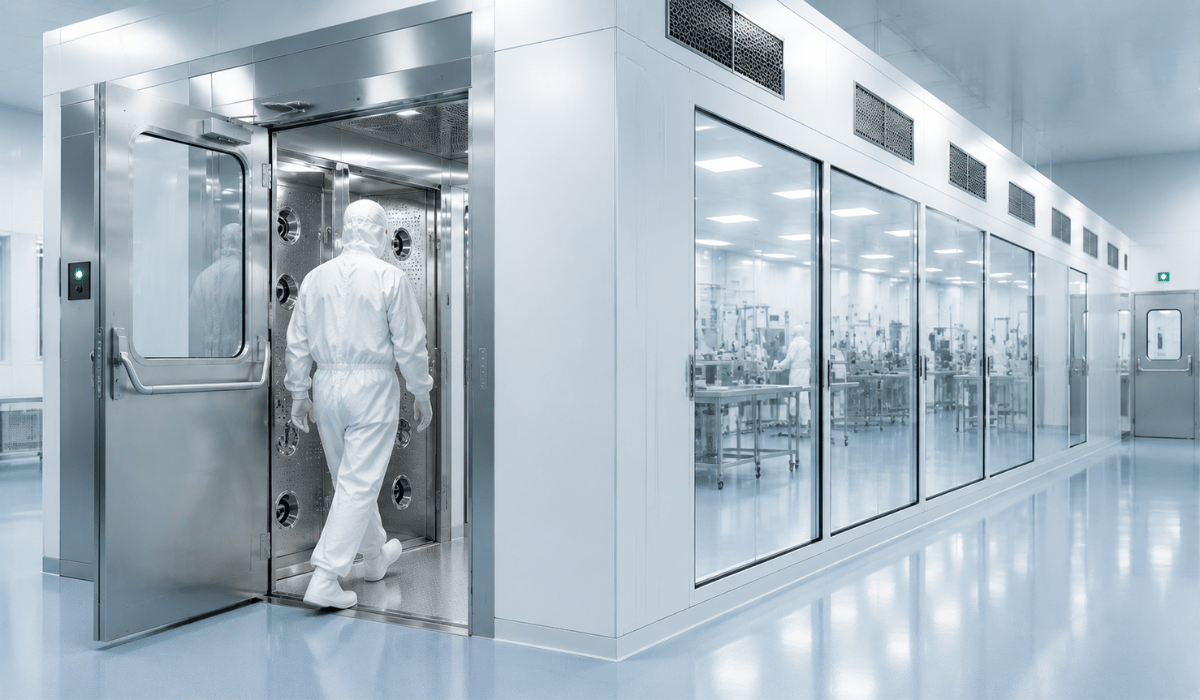
Maintaining strict contamination control does not always require a complex, fully ducted HVAC system.
For facilities with suitable operating conditions, a single-pass cleanroom can provide effective particle control while reducing construction complexity, installation time, and upfront costs.
A single-pass cleanroom is a controlled environment where filtered air enters the clean space once and then exits into the surrounding host facility instead of circulating through a dedicated return-air system.
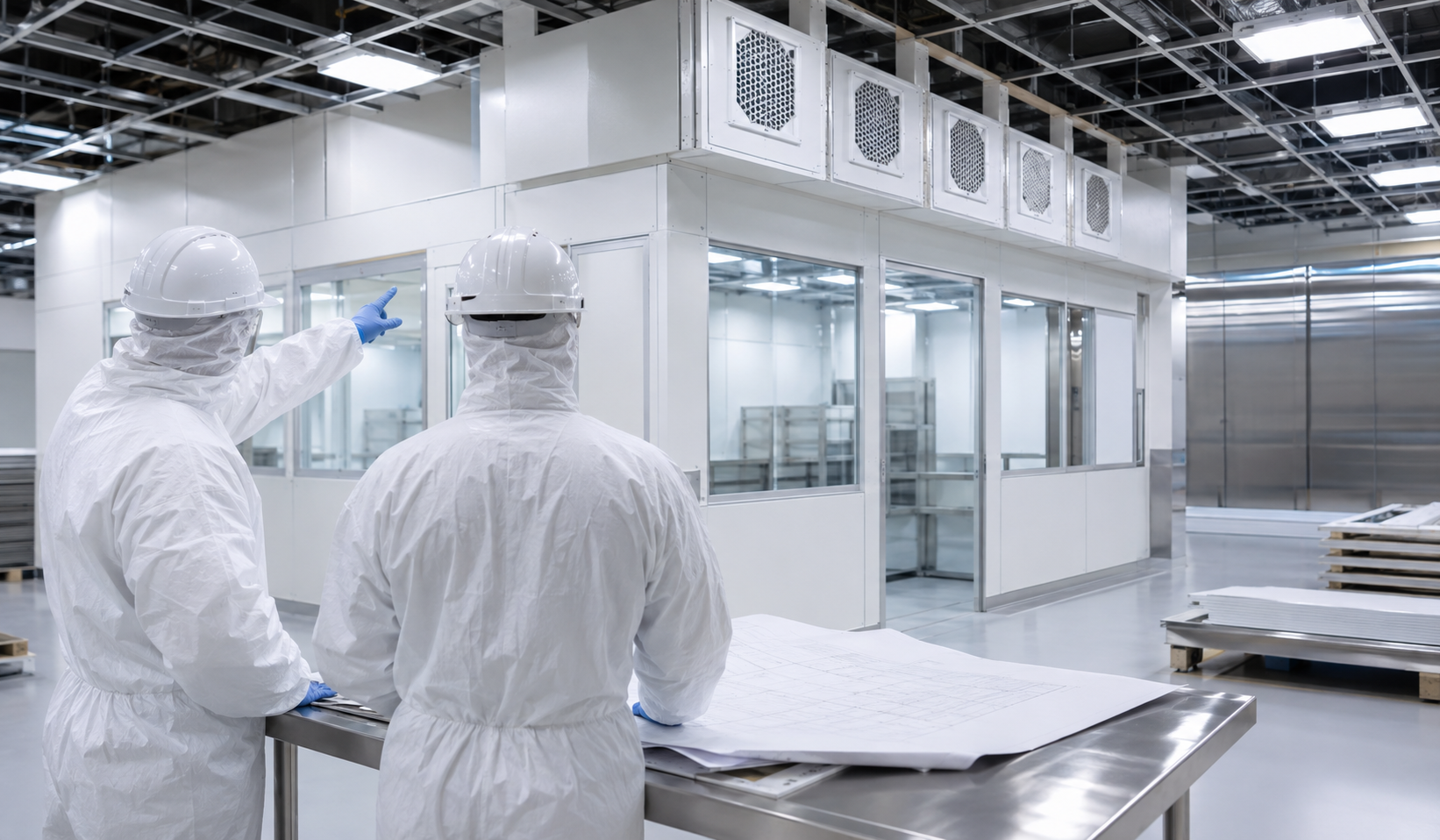
Ceiling-mounted fan filter units (FFUs) draw air from the host building and pass it through HEPA or ULPA filters.
According to the EPA, a HEPA filter can capture at least 99.97% of airborne particles measuring 0.3 microns, although actual filter selection should follow applicable testing standards and process requirements.
After moving through the cleanroom, the filtered air leaves through low-wall grilles, door gaps, or other designed pressure-relief openings.
Because the air is not returned through a closed cleanroom air loop, this system is also called a non-recirculating cleanroom.
This streamlined design can be a cost-effective and rapidly deployable alternative to a recirculating cleanroom, particularly within an existing climate-controlled facility. However, it is not suitable for every application.
The right airflow system depends on the required ISO classification, temperature and humidity tolerances, contamination risks, process emissions, exhaust needs, and host-building conditions.
How Does Single-Pass Airflow Work?
Single-pass airflow works by moving clean, filtered air through the room once.
The air then leaves the cleanroom and returns to the surrounding building.
The process has three simple steps:
1. Air Enters the System
Fan filter units (FFUs) are installed in the cleanroom ceiling. They pull air from the surrounding building or the space above the cleanroom.
2. The Air Is Filtered
The FFUs move the air through HEPA or ULPA filters. These filters capture very small particles before the air enters the cleanroom.
3. The Air Leaves the Room
After passing through the cleanroom, the air exits through wall grilles, door gaps, or other designed openings. It does not travel back through a dedicated return-air system.
The way air moves inside the room depends on the location of the FFUs, the room’s shape, the equipment, and the number of people working inside.
For this reason, it is more accurate to call it filtered downward airflow unless testing confirms that the airflow is unidirectional.
A single-pass cleanroom can also maintain positive pressure. This means the cleanroom has slightly more air pressure than the surrounding area.
The extra pressure helps keep less-clean air from entering through doors and small gaps. The pressure must be properly balanced and confirmed through testing.
Does ISO 14644 Require a Particular Airflow Design?
No, ISO 14644-1 does not require a cleanroom to use a specific airflow design. A cleanroom may use either single-pass or recirculating airflow.
The standard classifies a cleanroom by measuring how many airborne particles are present.
Having HEPA filters or several fan filter units (FFUs) does not automatically give a room an ISO classification.
Particle-count testing must confirm that the room meets the required limits.
Testing may take place when the room is:
- As built: The cleanroom is complete, but equipment and workers are not present.
- At rest: Equipment is installed and running, but workers are not present.
- Operational: Equipment and workers are performing normal activities.
Single-pass cleanrooms are often designed for ISO Class 7 or ISO Class 8 environments.
However, the result depends on the number and placement of FFUs, airflow, room size, equipment, workers, cleaning practices, door use, and particle levels in the surrounding facility.
You may also see the older terms Class 10,000 and Class 100,000. These names come from the withdrawn Federal Standard 209E. Today, ISO Class 7 and ISO Class 8 are the preferred terms.
Single-Pass vs. Recirculating Cleanrooms
The main difference between the two designs is how they manage return air.
| Feature/Metric | Single-Pass Cleanroom | Recirculating Cleanroom |
| Airflow path | Open loop (ambient air in, exhaust out) | Closed loop (air continuously recycled & filtered) |
| Ductwork Complexity | Minimal or unnecessary | High (requires extensive return air ducts) |
| Upfront CAPEX | Significantly lower | High initial investment |
| Installation Time | Rapid (days to weeks) | Extended (months) |
| Temp & Humidity Control | Relies entirely on the host building | Independent, high-precision HVAC control |
| Construction Style | Modular cleanroom construction | Hardwall built-in or heavy modular |
A recirculating system reuses air that has already been filtered and conditioned.
Proper cleanroom HVAC system design helps determine whether recirculating, single-pass, or another airflow configuration is appropriate for the facility’s contamination-control and environmental requirements.
This can make temperature and humidity easier to control. However, return-air chases, ductwork, air handlers, and controls can increase the initial cost and construction footprint.
A single-pass system reduces that mechanical complexity. Its performance, though, depends more heavily on the quality and stability of the surrounding facility.
Common Single-Pass Cleanroom Applications
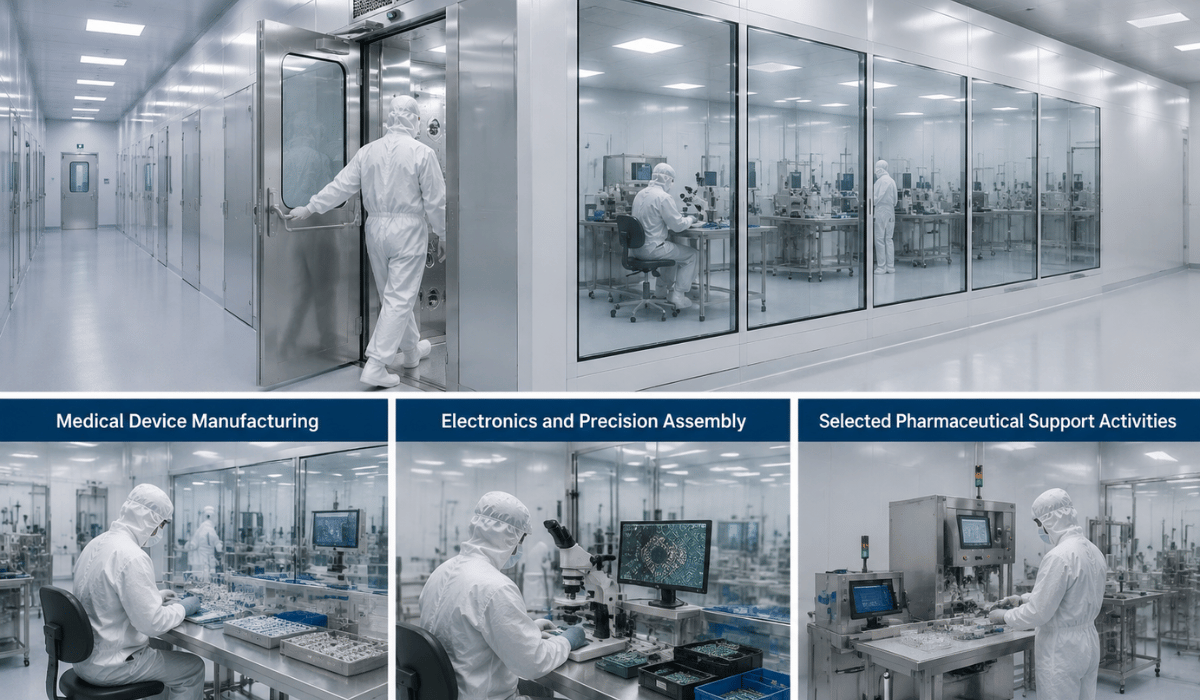
Medical Device Manufacturing
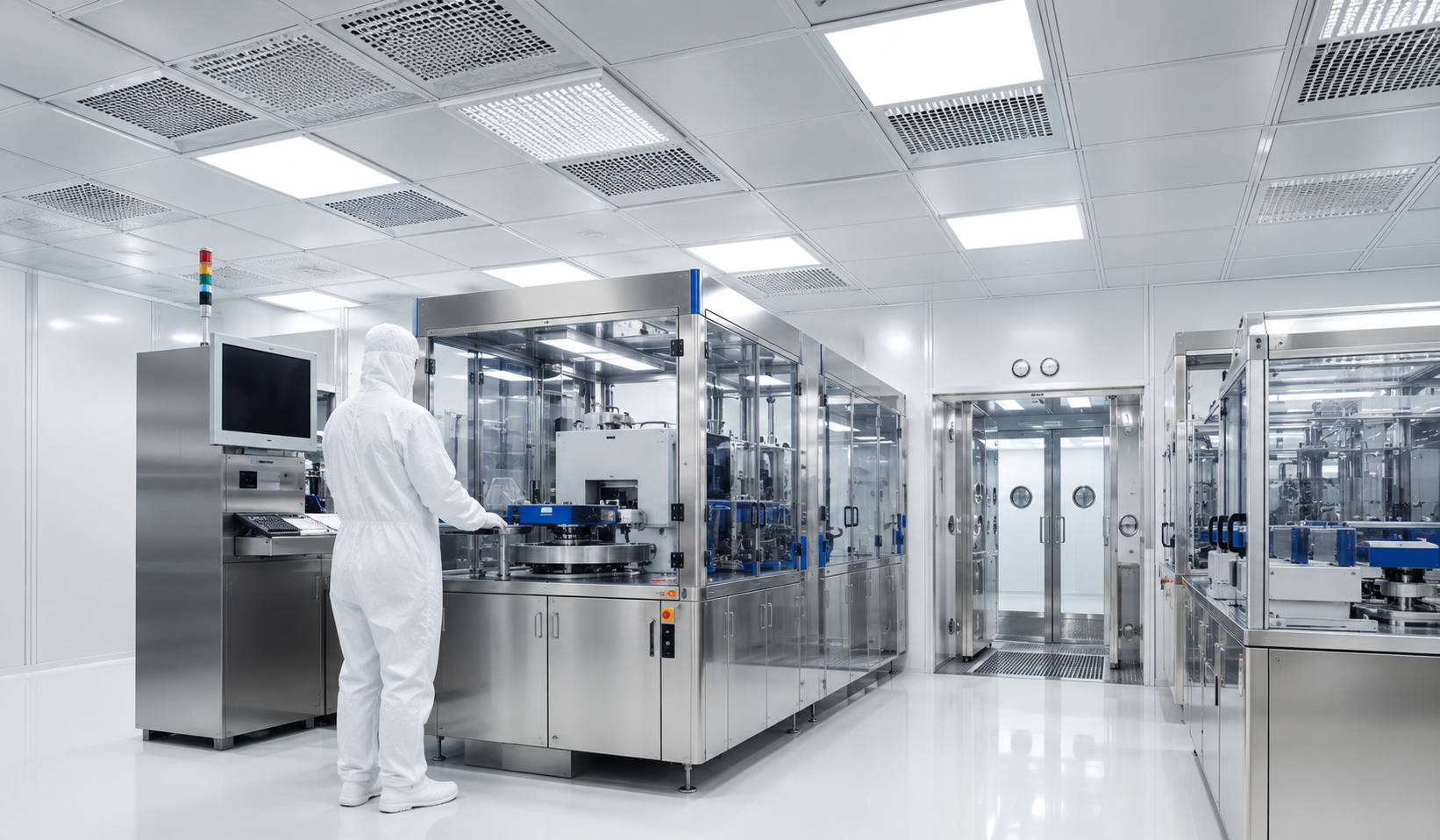
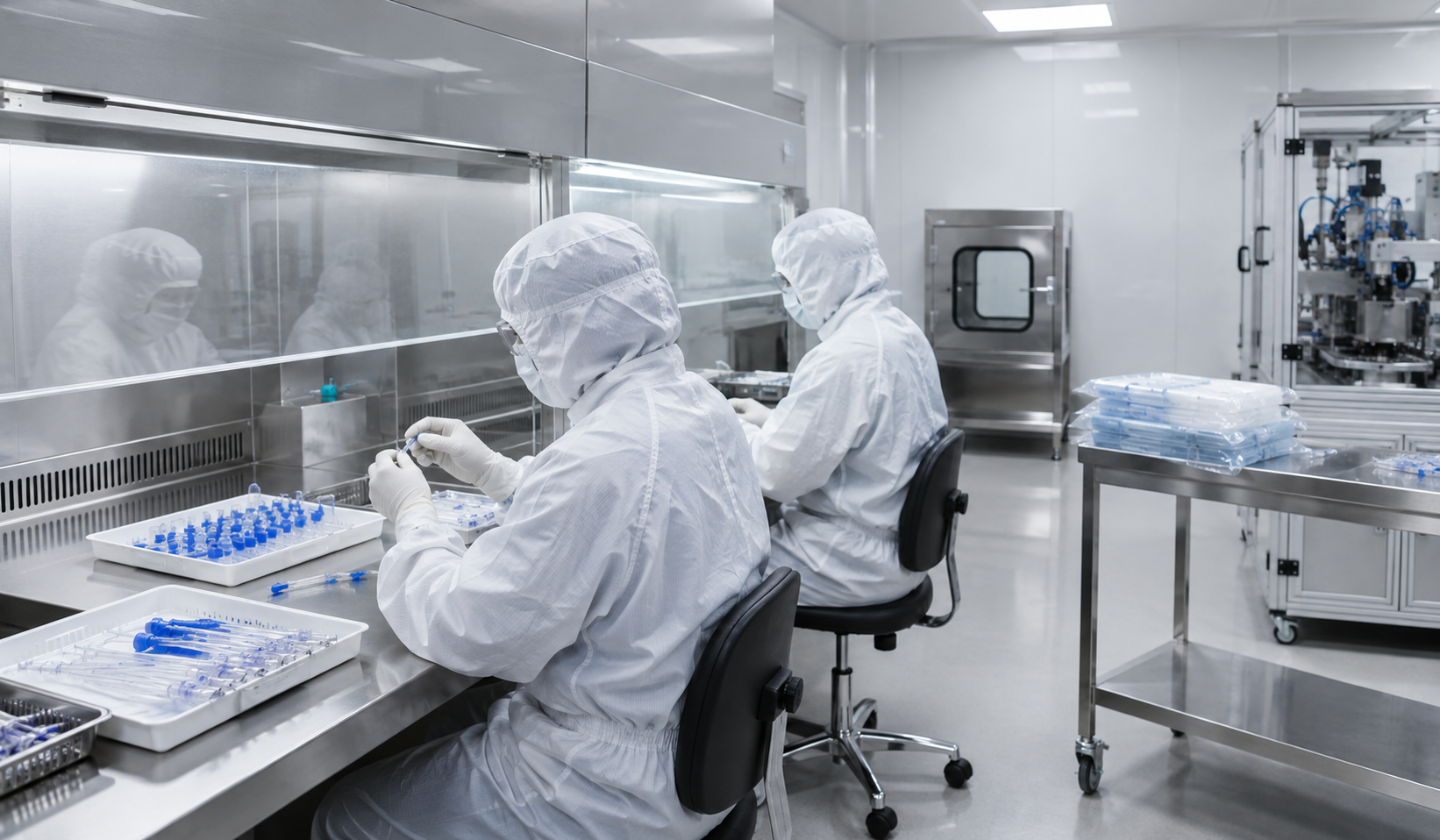
A medical device cleanroom may use single-pass airflow for selected component assembly, inspection, and packaging operations.
Suitability depends on product risk, cleanliness requirements, sterilization strategy, personnel activity, and regulatory expectations.
The room must still be tested and qualified for the required operating conditions. A modular system alone does not establish compliance.
Electronics and Precision Assembly
Dust and airborne particles can damage electronic components, optical products, sensors, and precision assemblies.
A HEPA-filtered cleanroom can reduce particle deposition during assembly, testing, and inspection.
Temperature, humidity, and electrostatic-discharge requirements must be evaluated separately.
Processes sensitive to moisture or static electricity may require additional environmental controls.
Selected Pharmaceutical Support Activities
Single-pass airflow may be considered for certain non-sterile support areas, secondary packaging, or lower-risk operations.
It should not be presented as universally suitable for pharmaceutical manufacturing or aseptic processing.
Pharmaceutical cleanroom design requires an evaluation of microbial risk, product exposure, cross-contamination, pressure relationships, temperature, humidity, cleaning, and applicable regulatory requirements.
Processes involving sterile products or potent active ingredients may require more advanced containment and air-handling systems.
What Are the Limitations of a Single-Pass System?
The main limitation is its dependence on the host facility. If the building becomes warm, humid, dusty, or unstable, conditions inside the cleanroom may also change.
A single-pass cleanroom may not be the right choice when:
- The process requires tight temperature or humidity tolerances.
- The host building has a high airborne particle load.
- Hazardous materials require containment or dedicated exhaust.
- Several connected rooms need carefully controlled pressure cascades.
- The required cleanliness level demands more advanced airflow control.
- The process generates substantial heat or moisture.
- The host HVAC system cannot manage the additional load.
If any of these conditions apply, a recirculating HVAC system or custom cleanroom design may provide more reliable control over airflow, pressure, temperature, and humidity.
How Do You Select the Right Cleanroom Design?
A single-pass cleanroom can be an efficient solution when the host facility is stable, the process is non-hazardous, and independent environmental control is unnecessary.
It may also offer faster installation and greater layout flexibility than a fully recirculating design.
However, the decision should be based on process requirements rather than cost alone.
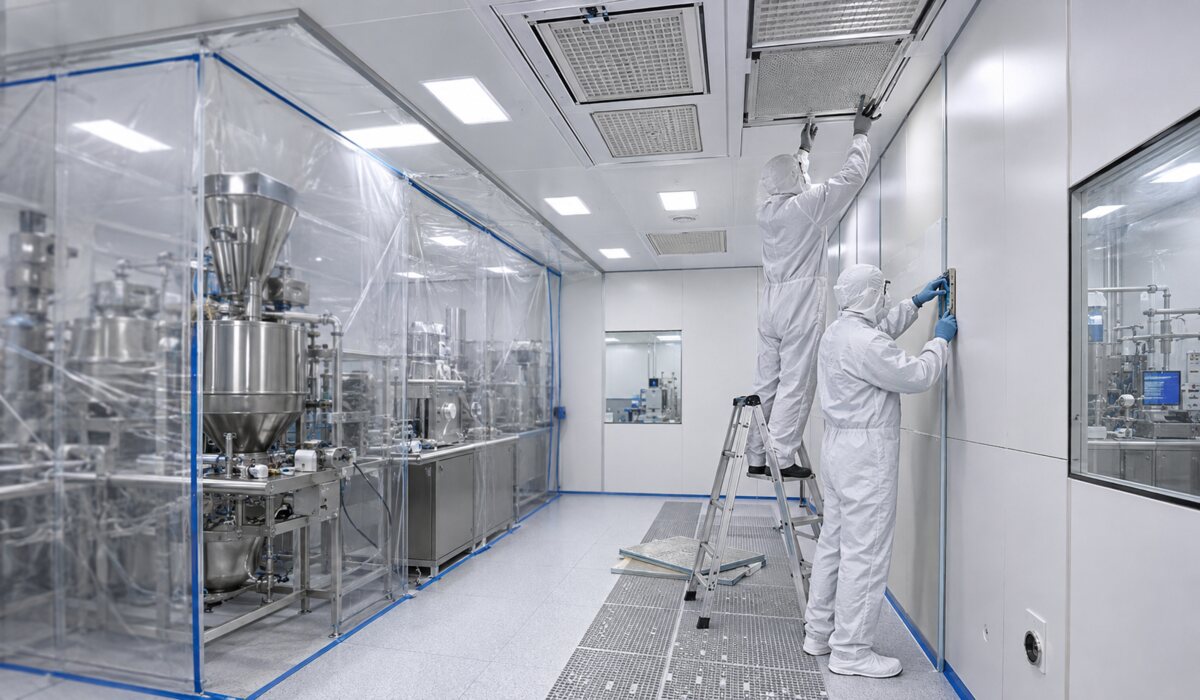
The cleanroom design and build process should evaluate airflow, filtration, ISO classification, environmental controls, equipment layout, occupancy, and future operational requirements before construction begins.
A cleanroom specialist should evaluate the target ISO classification, particle load, room size, equipment layout, occupancy, host HVAC capacity, pressure requirements, environmental tolerances, and future expansion plans.
Early cleanroom airflow design reduces the risk of installing a system that cannot maintain the required conditions once equipment and employees enter the room.
Need Help Selecting a Cleanroom Airflow System?
Don’t guess when it comes to contamination control. At Ultrapure Technology, our technical experts leverage 33 years of combined experience to evaluate your facility’s environmental requirements, process emissions, and ISO standards.
Based in Suwanee, GA, we design and build tailored single-pass, recirculating, and modular cleanroom systems that meet rigorous ISO and GMP compliance.
Connect with our engineering team today to get started.
Frequently Asked Questions
Can a single-pass cleanroom achieve ISO Class 7?
Yes, a single-pass cleanroom may achieve ISO Class 7 when it has sufficient FFU coverage, controlled leakage, appropriate cleaning procedures, and manageable particle generation. The classification must be confirmed through particle-count testing.
Is a single-pass cleanroom cheaper than a recirculating cleanroom?
It usually has a lower initial construction cost because it requires less return-air ductwork and mechanical infrastructure. Actual lifecycle cost depends on energy use, filter maintenance, host HVAC demand, monitoring, and operating schedules.
Can a single-pass cleanroom control humidity?
It primarily depends on the host building for humidity control. Supplemental conditioning may be added, but a recirculating or custom HVAC system is often more suitable when the process requires tight humidity tolerances.
Does ISO 14644 require recirculating airflow?
No, ISO 14644-1 establishes airborne particle concentration limits for cleanroom classification. It does not prescribe a single-pass or recirculating airflow design.
Can single-pass cleanrooms be used for medical devices?
Yes, they may be suitable for selected medical device assembly, inspection, and packaging processes. Product risks, cleanliness requirements, sterilization plans, and applicable quality-system requirements must be evaluated first.
How often should a single-pass cleanroom be tested?
Testing and monitoring frequencies depend on the ISO classification, process risk, facility monitoring plan, applicable regulations, and previous performance data. Testing may also be needed after filter replacement, equipment changes, facility renovations, or airflow modifications.
How clean is a Class 100 cleanroom?
A Class 100 cleanroom allows a maximum of 100 particles ($\ge 0.5\ \mu\text{m}$) per cubic foot of air. Under modern global standards, this corresponds directly to an ISO Class 5 environment (which permits up to 3,520 particles per cubic meter). For comparison, typical urban room air contains roughly 35,000,000 particles of that size per cubic meter, making a Class 100 environment roughly 10,000 times cleaner than standard ambient indoor air.