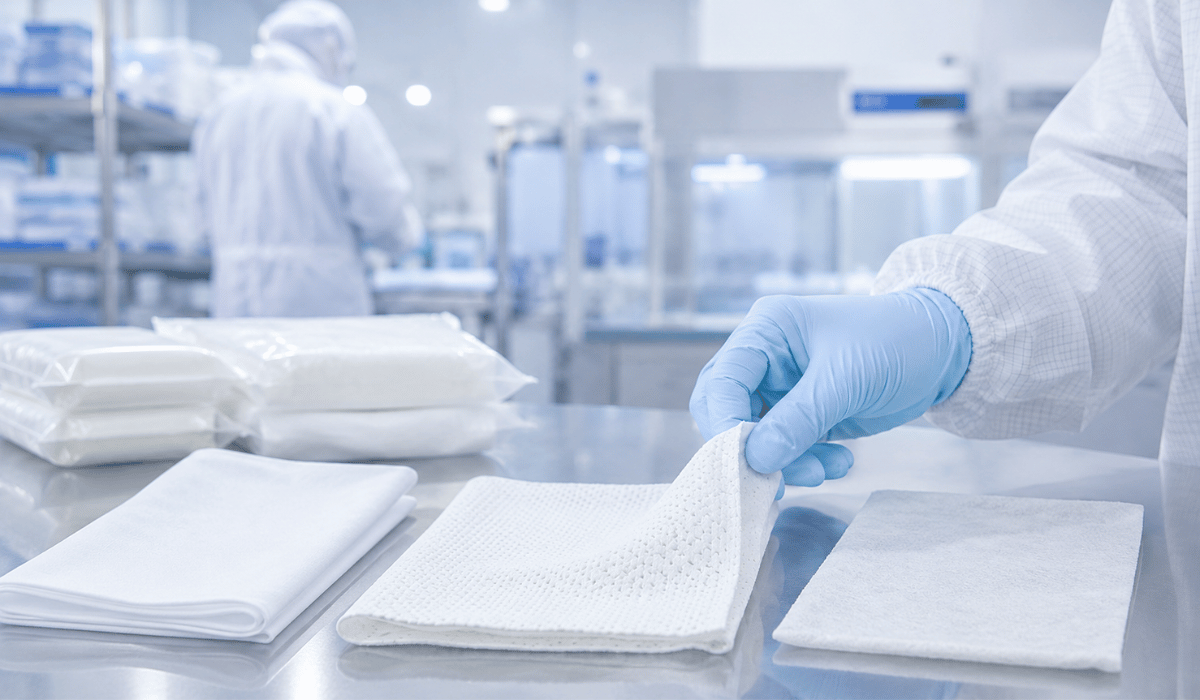
Choosing the right cleanroom wipers by ISO class requires more than checking the ISO classification printed on a product specification sheet.
The wiper must remove targeted contaminants without releasing unacceptable particles, fibers, ions, or chemical residues into the controlled environment.
A wiper suitable for cleaning a stainless-steel workstation may not work well on sensitive electronics, optical components, aseptic processing equipment, or solvent-sensitive surfaces.
Facilities must consider the room classification, contamination type, cleaning chemical, surface, sterility requirements, and documented wiper performance.
These requirements should align with the facility’s overall cleanroom design, contamination-control strategy, airflow, filtration, and operational processes.
ISO 14644 classification is based on airborne particle concentration and does not prescribe one specific wiper for each ISO class.
Therefore, ISO class-based recommendations should be used as evaluation starting points rather than fixed compliance requirements.
What Are Cleanroom Wipers?
Cleanroom wipers are specialized materials designed to remove contamination from surfaces without introducing excessive particles, fibers, ions, or chemical residues.
Unlike paper towels, shop cloths, and general-purpose wipes, they are manufactured and processed for controlled environments.
Cleanroom wipers perform three primary functions:
- Particle removal: Capture dust, fibers, and microscopic debris without spreading them across the surface.
- Liquid absorption: Collect spills, solvents, cleaning agents, and process liquids with minimal residue.
- Surface preparation: Prepare surfaces for coating, bonding, assembly, or inspection.
They are also used to apply disinfectants, remove oils and fingerprints, and clean equipment, tools, workstations, and sensitive components.
Cleanroom wipers are available in various materials, sizes, textures, edge treatments, and packaging formats.
Depending on the application, they may be dry or pre-saturated, sterile or nonsterile, and laundered or non-laundered.
The term “lint-free” does not mean a wiper releases no fibers under every condition.
It indicates that the product is designed to minimize shedding. Actual performance depends on the material, surface, cleaning chemical, wiping technique, and whether the wiper is used wet or dry.
How to Choose Cleanroom Wipers by ISO Class
The following recommendations are risk-based starting points not universal ISO requirements.
| ISO classification | Main evaluation priorities | Possible starting point |
| ISO Classes 3–5 | Very low shedding, low residue, controlled packaging and sealed edges | Laundered knitted polyester or qualified microfiber |
| ISO Classes 6–7 | Balance of cleanliness, durability, absorbency and compatibility | Polyester, microfiber or qualified nonwoven materials |
| ISO Class 8 | Absorbency, controlled shedding, durability and economical use | Qualified polyester-cellulose, polyester or task-specific wipes |
ISO Classes 3–5
Facilities operating at these stringent cleanliness levels commonly evaluate wipers with documented low particle and fiber release.
Selection criteria may include:
- Laundered knitted polyester
- Laser-cut or ultrasonically sealed edges
- Low APC and LPC results
- Low nonvolatile residue
- Controlled packaging
- Lot traceability
- Sterility when required
An ISO Class 5 pharmaceutical area may need sterile, low-shedding wipes compatible with an approved disinfectant.
An ISO Class 5 electronics facility may prioritize particles, ions, solvent compatibility, and electrostatic controls without requiring sterility.
ISO Classes 6–7
These classifications support many medical-device, electronics, aerospace, pharmaceutical support, and laboratory processes.
Knitted polyester may suit sensitive surfaces. Microfiber may help remove oils and films.
Polyester-cellulose wipes may support routine cleaning and spills when their shedding and residue characteristics meet the facility’s criteria.
Different wipes may be assigned to different zones or tasks. Clear labels or color coding can help prevent a spill-control wipe from being used on a product-contact surface.
ISO Class 8
ISO Class 8 environments may permit a wider range of qualified materials, including absorbent nonwoven wipes. This does not mean ordinary consumer or commercial wipes are automatically acceptable.
A medical-device packaging operation, for example, may require tighter material controls than a general support area with the same ISO classification.
Why Does Cleanroom Wiper Selection Matter?
Wiping is intended to remove contamination, but an unsuitable wiper can become a source of contamination itself.
The wrong wiper may:
- Shed particles or fibers
- Leave chemical residues
- React with the cleaning agent
- Scratch sensitive surfaces
- Spread contamination across the surface
- Release ions that affect electronic components
- Interfere with adhesives, coatings, or bonding processes
- Break apart when saturated
- Absorb too little or release too much liquid
The consequences vary by industry. In pharmaceutical manufacturing, wipers must support established cleaning and disinfection procedures. In medical-device production, fibers or residues may affect product cleanliness.
Electronics manufacturers may be concerned about particles, ionic contamination, oils, and electrostatic discharge. Aerospace facilities may need to protect precision surfaces, sensors, optics, or specialized coatings. Laboratories may use different wipes for routine benchtop cleaning, chemical spills, equipment maintenance, and sensitive instruments.
Wiper selection should therefore be included in the facility’s broader cleanroom contamination control program.
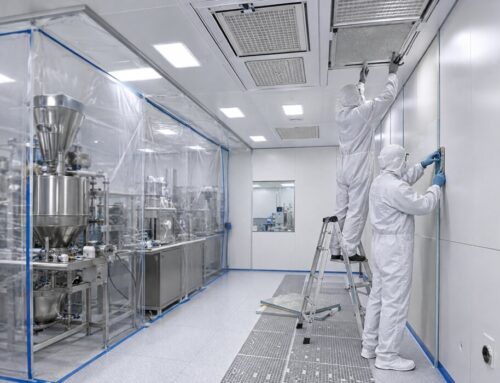
The cleaning protocol should also account for the surfaces and materials used in modular cleanroom systems, particularly where frequent cleaning or disinfection is required.
Understanding different cleanroom wiper materials can help facilities compare particle shedding, absorbency, chemical compatibility, durability, and suitability for specific cleaning tasks.
Comparing Common Cleanroom Wiper Materials
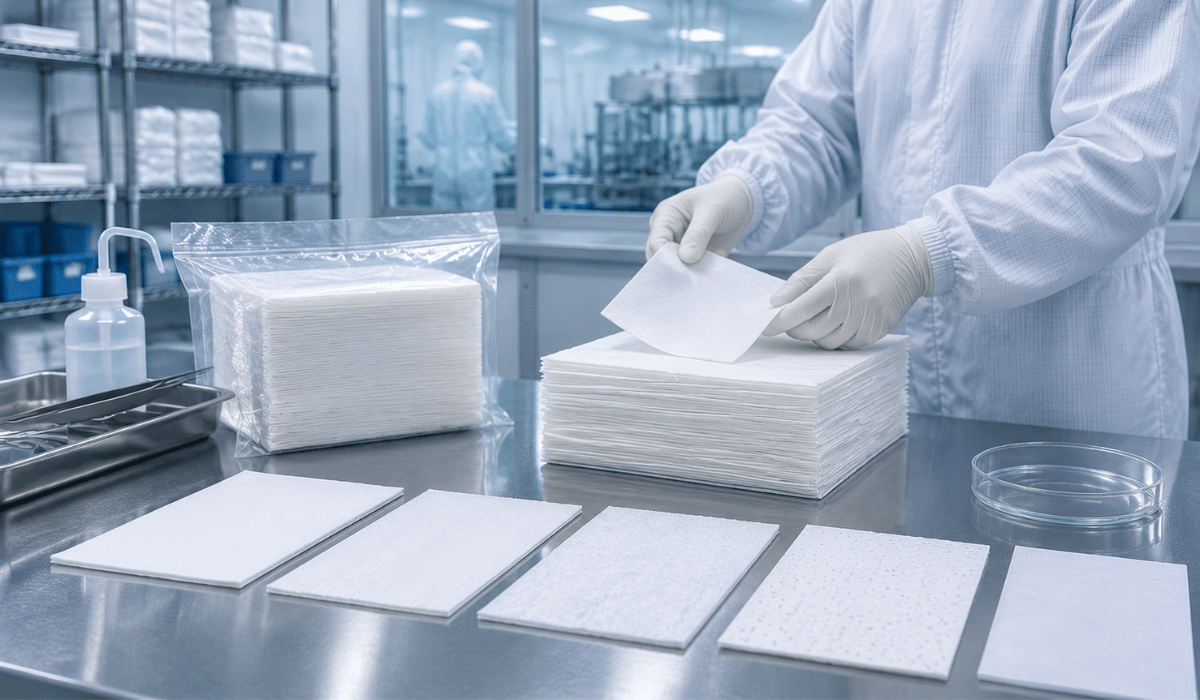
| Material | Common strengths | Potential limitations | Typical applications |
| Knitted polyester | Low shedding, durable, good solvent compatibility | May absorb less water than cellulose blends | Critical surfaces, equipment and electronics |
| Polyester-cellulose | Absorbent and economical | May release more fibers or extractables | Routine cleaning and spill collection |
| Microfiber | Effective for oils, fingerprints and fine particles | Compatibility and abrasion require evaluation | Optics, displays and polished surfaces |
| Polypropylene | Chemical resistance and oil pickup | Limited absorption of some water-based liquids | Oil, grease and selected solvent cleaning |
| Foam | Soft contact and controlled liquid application | May degrade with incompatible chemicals | Delicate equipment and confined areas |
Knitted Polyester
Knitted polyester wipes are strong and do not leave many loose fibers behind. They work well for careful cleaning and can be used with many cleaning liquids. Clean and sealed-edge types may suit ISO Classes 3–5 after proper testing.
Polyester-Cellulose Nonwoven
These wipes are strong and can soak up a lot of liquid. They are useful for everyday cleaning and spills. Test them before using them near sensitive parts because they may leave fibers or residue behind.
Microfiber
Microfiber wipes have very fine fibers. They can pick up oil, fingerprints, thin films, and tiny particles. They work well on glass, screens, and smooth surfaces. Make sure they do not scratch the surface or leave residue.
Polypropylene
Polypropylene wipes are useful for cleaning oil and grease. They can also handle certain chemicals. However, they may not soak up water as well as oil, so choose them based on the type of spill.
Foam Wipers
Foam wipes are soft and gentle. They can apply a small and controlled amount of cleaning liquid. They are useful for delicate parts, small openings, and hard-to-reach areas. Test them with the cleaning chemical before use.
Conclusion
ISO classification provides a useful starting point, but it does not determine the right wiper by itself. The final choice must suit the cleaning task, surface, chemical, and contamination risk.
A cleanroom specialist can help assess these requirements and select a wiper that supports effective cleaning without creating additional contamination.
Need Help Choosing the Right Cleanroom Wiper?
Selecting a cleanroom wiper isn’t just about matching the ISO class.
Factors such as material composition, absorbency, lint generation, chemical compatibility, and application all affect cleaning performance and contamination control.
If you’re uncertain which option is right for your facility, our team at UltraPure Technology can help you identify the most suitable cleanroom wiping solution based on your industry, cleaning process, and compliance requirements.
Contact us to discuss your needs or request additional product information.
Frequently Asked Questions
What type of cleanroom wiper is recommended for ISO Class 5?
ISO Class 5 environments generally require cleanroom-laundered, 100% continuous-filament knitted polyester wipers with laser-sealed or ultrasonically sealed edges. Microfiber wipers engineered for cleanroom use are also widely qualified.
Can standard commercial wipes be used in ISO Class 8 cleanrooms?
No, standard commercial wipes release millions of uncounted particles, natural fibers, binders, and ionic contaminants that break air quality baselines and contaminate equipment surfaces.
What is the difference between sterile and non-sterile cleanroom wipers?
Sterile wipes undergo validated sterilization (typically Gamma Irradiation) to achieve a Sterility Assurance Level (SAL) of $10^{-6}$. Non-sterile wipes may have low particle counts but are not certified free from viable microorganisms. Aseptic processing zones require sterile wipes.
How do I validate cleanroom wipers for my facility?
Request technical data sheets (TDS) detailing LPC, APC, NVR, and extractable ions from your vendor. Perform in-house physical trials testing chemical compatibility, abrasion resistance, and wiping efficacy under actual operating conditions.
Why are cleanroom wipers critical in semiconductor and microelectronics manufacturing?
Sub-micron particles can bridge microscopic circuit pathways, leading to short circuits and component failures. Every wiping action in wafer fabrication, chip packaging, and display manufacturing directly impacts product yield, making low-shedding synthetic wipers essential for operational profitability.
How are cleanroom wipers regulated in medical device manufacturing?
Under regulations such as FDA 21 CFR Part 820, medical device facilities must maintain documented contamination control procedures. Wipers used during the assembly of implantables, surgical instruments, and diagnostic tools must minimize fiber release to prevent foreign-body contamination.
Why is lot traceability important for cleanroom wipers in aerospace and defense?
Contamination on satellite hardware, avionics, or optical sensors can lead to total mission failure. Aerospace applications require certified wipers with full lot traceability to verify that low-outgassing, solvent-compatible, and low-extractable standards are met for every batch used.
What function do wipers serve in PCB and SMT assembly lines?
In printed circuit board (PCB) and surface-mount technology (SMT) lines, specialized wipers are used for stencil cleaning, solder paste removal, and post-reflow wipe-downs. Using low-residue wipers prevents bridge shorting and minimizes costly rework on high-density assemblies.